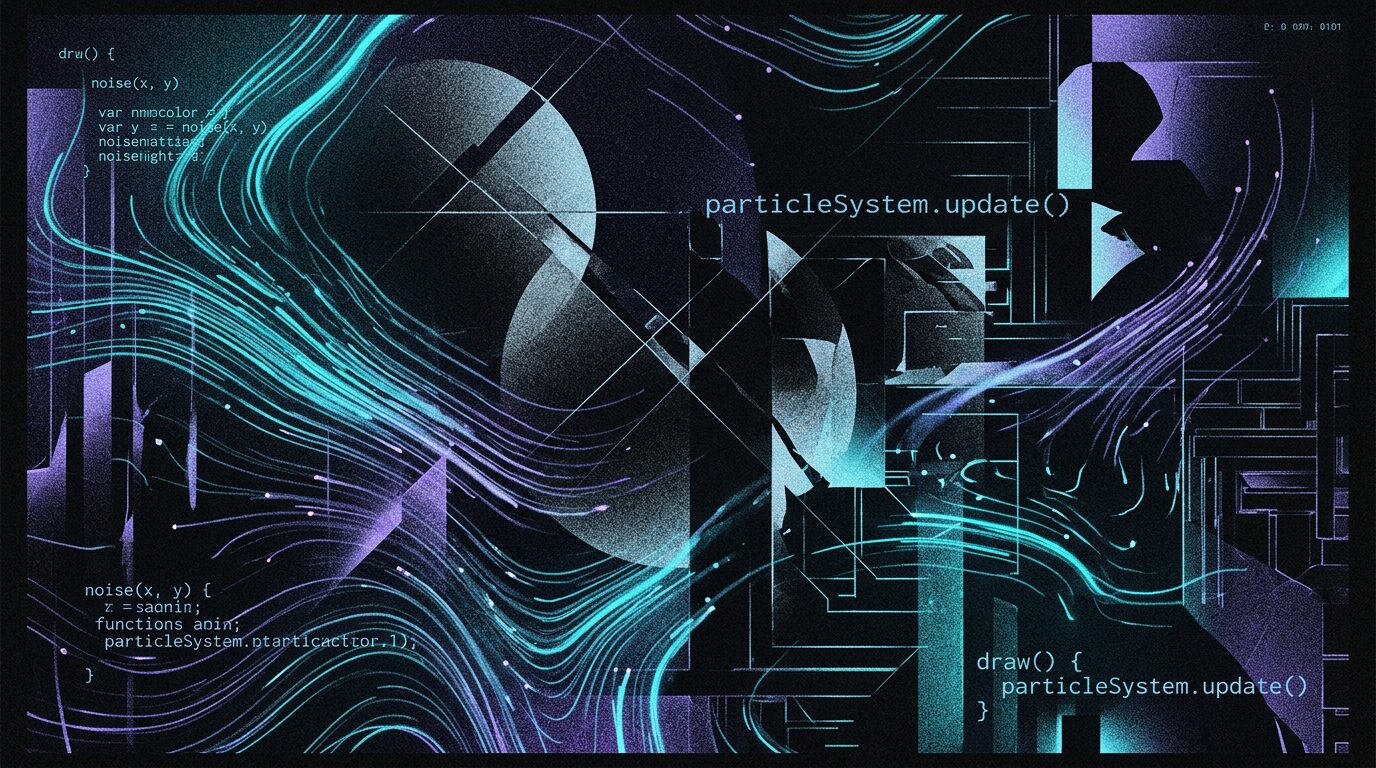

# p5.js and Generative Art in the Brand Toolkit
A brand toolkit is a set of constraints that produce consistency. Color palettes, typography scales, spacing rules, tone-of-voice guidelines — these are the boundaries that make a hundred outputs look like they came from the same source. The Lucid Studio brand toolkit adds a layer most toolkits do not have: generative art. Not decorative generative art, not algorithmic wallpaper, but production generative art that produces hero images, social assets, background textures, and interactive experiences — all constrained by the same visual language that governs the rest of the pipeline. The engine behind this is p5.js, and its integration into the brand toolkit is the subject of this article.
Why generative art belongs in a brand toolkit
Most brand toolkits are static. They define what exists: the logo, the colors, the typefaces, the approved layouts. They do not define how to produce new assets at speed. When the pipeline needs a hero image for an article, a background for a product page, or a set of social media visuals, the static toolkit offers a starting point (the palette, the style) but no mechanism for production. The result is either manual design work (slow, expensive) or AI image generation with a prompt (fast, but unconstrained by the brand language unless the prompt is engineered to enforce it).
Generative art solves this differently. A p5.js sketch is an algorithm that produces visuals. Parameterize that algorithm with the brand palette, the brand’s noise vocabulary, the brand’s shape language, and every output is brand-consistent by construction. The algorithm is the brand guideline, encoded in code rather than a PDF. When the pipeline needs a new asset, it does not ask a designer to create one from scratch — it runs the algorithm with new parameters and gets an output that belongs to the same visual world as everything else.
The p5.js integration
p5.js is the creative coding framework that makes this possible. It runs in the browser, renders to canvas, and exports as PNG, GIF, or SVG. The Lucid Studio pipeline uses it in three modes:
Static hero generation. A p5.js sketch with `noLoop()` renders a single frame. The brand palette is injected via a CONFIG object. Noise seeds are deterministic — same seed, same output. The pipeline runs the sketch with parameters drawn from the article’s metadata (series number, topic tags, color temperature) and produces a hero image that is brand-consistent without manual intervention. The sketch is the brush; the algorithm is the art direction.
Animated backgrounds. For product pages and landing experiences, p5.js sketches run in `draw()` loop mode, producing looping animations that respond to scroll position or mouse interaction. The same brand constraints apply: the same palette, the same noise vocabulary, the same shape language. The animation is not a video file — it is a live algorithm that renders in the browser, adaptive to the viewer’s device and viewport.
Interactive brand experiences. The p5js skill’s interactive mode produces sketches that respond to user input — mouse position, keyboard state, touch events. These become product configurators, visual identity explorers, or generative art pieces that let the viewer participate in the brand’s visual language. Each interaction is a new instance of the same algorithm, producing unique-but-branded output.
How the algorithm encodes the brand
The brand language is cypherpunk goth: dark surfaces, neon accents in cyan and violet, high contrast, architectural geometry, grain texture. In a traditional brand toolkit, these are described in words and illustrated with examples. In the p5.js integration, they are code:
The palette is a CONFIG object. `bg: ‘#0a0a0f’` (near-black), `primary: ‘#00e5ff’` (neon cyan), `secondary: ‘#7c3aed’` (violet), `accent: ‘#ff006e’` (hot pink). Every `fill()` call references this palette. The algorithm cannot produce a wrong color because the palette is the only source of color values.
The noise vocabulary is multi-octave Perlin with domain warping. This produces the flowing, organic textures that define the brand’s visual texture — not smooth gradients, not hard edges, but the kind of noise that looks like it was captured on a sensor that was never meant to exist. The same noise parameters (`octaves: 4, lacunarity: 2.0, gain: 0.5`) appear across every generative output.
The shape language is geometric primitives with grain. Circles, rectangles, and lines — but rendered with `p5.grain` texture overlays and subtle stroke weight variation that makes everything feel hand-rendered rather than computer-generated. The grain is the brand’s fingerprint: it appears in every generative output, just as it appears in every photograph and every ComfyUI render.
The pipeline integration
The p5.js sketches are not standalone art projects. They are components of the creative pipeline that also includes ComfyUI, the clipping agent, and the AI animation factory.
The clipping agent feeds video clips from Telegram into the pipeline. Some of those clips become ComfyUI style-transfer subjects. Others become p5.js inputs — frame data that drives generative algorithms, producing hybrid outputs where photographic content and algorithmic rendering occupy the same frame.
ComfyUI handles photorealistic and semi-realistic image generation. p5.js handles abstract, geometric, and interactive content. The brand toolkit covers both: the same palette, the same grain, the same dark aesthetic. A hero image might be a ComfyUI render with a p5.js-generated overlay — grain texture, geometric accents, neon glow — that brands it as Lucid Studio even if the base image came from a different source.
The AI animation factory chains ComfyUI renders into video. p5.js provides the motion graphics layer: title cards, transition effects, background animations that ComfyUI cannot produce because ComfyUI renders frames, not algorithms. The factory stitches them together: ComfyUI provides the content, p5.js provides the brand, ffmpeg provides the final render.
Production constraints
The p5js skill enforces several production constraints that keep the generative art within brand bounds:
Seeded randomness. Every sketch uses `randomSeed()` and `noiseSeed()`. Same parameters, same output. This is not just reproducibility — it is auditability. When a client asks “where did this image come from?”, the answer is a seed value and a parameter set, not a vague “the AI made it.”
Performance budgets. Interactive sketches must hold 60fps. Animated exports must hold 30fps. The p5js skill’s performance targets cap particle counts, pixel operations, and draw calls. These are not arbitrary limits — they are the boundary between “generative art that works” and “generative art that stalls the browser.”
Export format discipline. Hero images export as PNG at the target resolution. Animated backgrounds export as GIF or MP4. Interactive sketches export as self-contained HTML. The pipeline expects specific formats and resolutions; the p5.js integration delivers them.
Brand palette enforcement. The CONFIG object is the single source of truth for colors. The sketch never hardcodes RGB values. The palette is injected at runtime, which means the same algorithm can produce outputs for different brand contexts (Lucid Studio, client brands, experimental series) by swapping the palette — without changing the algorithm.
What this proves
The integration of p5.js into the brand toolkit demonstrates something larger than “generative art looks cool.” It demonstrates that a brand language can be encoded as an algorithm rather than a document. The algorithm is auditable (same seed, same output), parameterizable (swap the palette, get a different brand), and composable (combine with ComfyUI, clipping agent, animation factory). The brand toolkit is no longer a set of static assets — it is a living system that produces assets on demand, constrained by rules that are enforced by code rather than human attention.
This is the difference between a brand guideline and a brand engine. The guideline tells you what the brand looks like. The engine produces what the brand looks like, every time, at speed, without deviation. The p5.js integration is one component of that engine. The creative pipeline that surrounds it — ComfyUI, clipping agent, animation factory — are the others. Together, they form a production system that generates brand-consistent visual content at a pace that static toolkits cannot match.
*Grounded in wiki concepts `p5js`, `creative-pipeline`, `comfyui`, `clipping-agent`, `ai-animation-factory`. Skills: `p5js`, `lucidhive-wp-publish`, `creative-pipeline`, `baoyu-article-illustrator`. Seventh article in the S9 series on Media & Creative Pipeline. Design notes on a running system, not a sales pitch.*