
</p>
Orphan Triage Policy: Merge vs Link vs Archive
Information becomes geometry, geometry becomes art. What is not transcribed does not exist for the fleet; what is not connected cannot compound.
— SECTOR9 North Star, Principles 1, 6, 7, and 15
🔓 PUBLIC — An orphan is a decision debt
A knowledge graph is a collection of records plus the paths between them. When a node has no inbound edge, a reader or agent cannot arrive there from the living graph. The record may contain excellent material, but it is not yet part of the system’s usable context. This is the specific problem surfaced by the accepted SECTOR7 orphan cluster: concepts exist outside the graph’s normal traversal routes.
An orphan is not automatically wrong, and it is not automatically garbage. It may be a distinct concept waiting for a home, a duplicate whose identity drifted during migration, or a valid record whose current field has no active use. Treating all three cases alike produces bad maintenance. Automatically linking everything creates decorative topology. Automatically merging everything erases distinctions. Automatically archiving everything hides useful frontier knowledge.
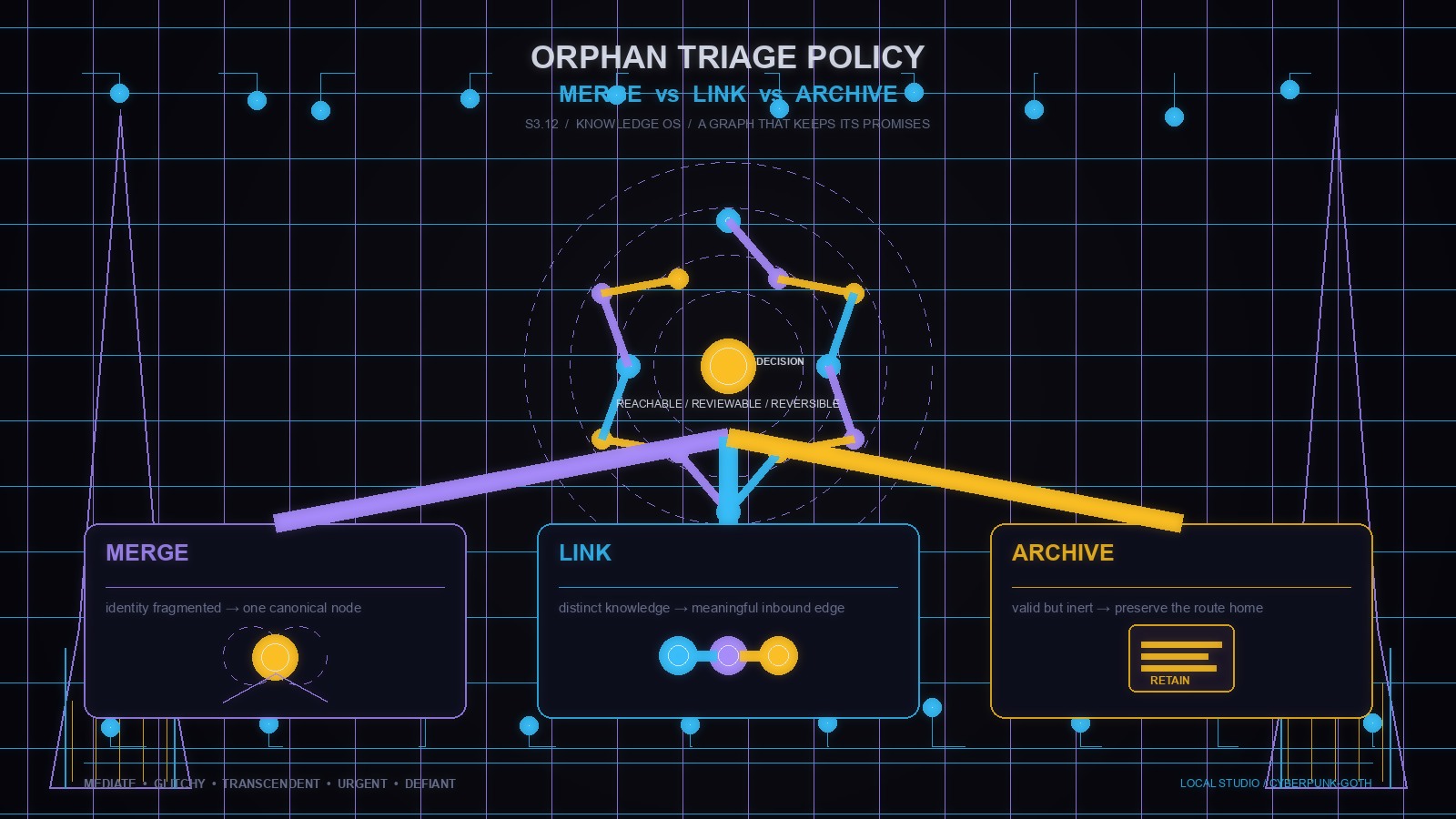
The durable answer is a triage policy with three dispositions: merge, link, or archive. The point is not to force every file into the active graph. The point is to make every orphan’s status explicit, preserve its provenance, and prevent unreviewed ambiguity from becoming normal.
🔓 PUBLIC — Link when the knowledge has a real home
Linking is the right response when the orphan is genuinely distinct and a source record should naturally reference it. The relationship must be useful in reverse: a future agent walking from the source toward its neighbors should discover the orphan because it answers a relevant question.
Start with evidence already present in the record. Identifiers, aliases, references, and semantic relationships can suggest the destination. A pricing contradiction, for example, may belong beside canonical pricing, tier, or revenue records when those records can reasonably link to it. The relationship is not created by proximity or file age. It is created by meaning.
A link should be anchored in the source, not merely declared by the orphan. If an isolated note says it is related to a concept but no living record points back to it, the system still cannot traverse toward the note. Add a contextual reference in a related entity, article, or topic node. Include a sentence explaining why the relationship exists. A bare link can be technically valid and editorially useless.
Verification is simple: inbound-edge count rises, the edge resolves, and a graph walk from the connected region can reach the node. The record has joined the living topology without being forced into a duplicate identity.
🔓 PUBLIC — Merge when identity has fragmented
Merging is appropriate when two records answer the same question under different names. Renames, copied drafts, and migrations can fragment one concept across several notes. Zero inbound links are not the cause, but they expose the fragmentation: neither copy has a clear canonical home.
A merge is not deletion. Before consolidating, diff the records and identify unique claims, evidence, terminology, and relationships. Choose the canonical node deliberately. Move only verified unique material into it, preserve the alternative title or identifier as an alias, and retain enough provenance to explain where the absorbed record came from. Then leave a tombstone or redirect at the old address so existing references do not become broken.
Do not merge on title similarity alone. A similarly named concept can still be a different concept. Nor should merging become an excuse to flatten ambiguity. If the records disagree in scope, preserve the distinction and link the narrower node from the broader one. If one is speculative, label it accordingly. If one is a historical interpretation rather than the canonical concept, move it to archive instead.
The public test is reader value: after the change, will one consolidated record serve the question more clearly than the fragmented set? If yes, merge. If no, keep the identities and repair the paths.
🔓 PUBLIC — Archive when the record is valid but currently inert
Archiving is not deletion. It is an honest boundary around knowledge that does not yet have an honest place in the active graph. A specialized research record, an abandoned experiment, or a framework for a domain the fleet does not currently traverse can all be legitimate archive candidates.
Archive only after asking two separate questions. First, is the content valid enough to preserve? Second, is there a real inbound relationship in the present system? If both answers are yes, move the record into a clearly named archive area and add explicit metadata: the original path, archive date, reason for disposition, and any condition that would justify restoration. The archive becomes a state, not a trash can.
The condition matters. A dormant record may become valuable when a neighboring field expands. A future agent should be able to discover it, evaluate it, and reactivate it without reconstructing its history from memory. That is the continuity principle in practice: archives preserve context so the next worker inherits a decision, not just a file.
Never use archive as a shortcut for an unresolved merge or a missing inbound link. If the reason is “we could not find the right relationship,” the correct status is needs-review, not archived. The policy is only useful when each disposition means something distinct.
🔓 PUBLIC — A repeatable triage gate
The policy can be expressed as a small operating loop:
- Detect. A graph audit reports active nodes with zero inbound relationships.
- Inspect. Review the record, its neighbors, identifiers, and evidence.
- Classify. Choose link, merge, or archive based on the questions above.
- Apply. Make the smallest change that records the decision.
- Verify. Rerun traversal, alias, and inbound-edge checks.
- Track. Store the disposition, actor, date, and reversible conditions.
This loop should run after migrations, bulk imports, and topic changes, and whenever an orphan report introduces new nodes. It is better to maintain a small reviewed queue than to wait for a large cleanup campaign. Large campaigns find classes of damage; frequent small passes prevent the classes from accumulating.
Automation may collect evidence and suggest candidates, but it should not silently rewrite a knowledge graph. Similarity scores, missing-link heuristics, and name matches are inputs to review, not decisions. A human or accountable agent still chooses the disposition, records the reason, and verifies the result. This keeps the policy repeatable without confusing pattern matching with truth.
🔓 PUBLIC — The council’s knowledge system stays honest
The SECTOR9 north star asks the system to treat information as ground, transcription as a first act of power, and continuity as more important than the appearance of completion. A triage policy brings those principles into an operational boundary. It does not demand that every node be active. It demands that every stranded record have an intentional status.
The accepted SECTOR7 cluster points to orphan wiki concepts and gives the policy a concrete test: knowledge that is not reachable is knowledge that is not compounding. Merge when identity is fragmented. Link when a meaningful home exists. Archive when a valid record has no active home, while preserving the conditions for its return.
That is the difference between a graph and a pile of notes. A graph makes change legible. It preserves the route, the reason, and the next move. When the next worker inherits it, the system has not merely stored information; it has made information usable.
Series entry: S3.12 — Orphan triage policy: merge vs link vs archive. Grounded in the accepted SECTOR7 cluster cl-graph-orphan-entities and SECTOR9 North Star Principles 1, 6, 7, and 15. This PUBLIC export excludes protected formulas, scoring weights, routing internals, client specifics, and source paths.
Vibe: meditative + glitchy + transcendent + urgent + defiant. The graph records; triage makes the route honest.