
# OpenClaw: The Creative Catalyst
> **Draft — S5.5 · series: CONTENT-ROADMAP-99 S5 (The Council System) · status: DRAFT · grounding: wiki openclaw + council-of-three + the-9-orders + multi-profile-agent-architecture + skills (lucidhive-wp-publish, comfyui, creative-pipeline) · tags: ai agents, creative-ai, media-generation, openclaw, council-system, digital-architecture, mcp-protocol, fire-element**
> Publish path: new post → lucidhive.com → tag + bridge.
—
The Council of Three is three parents, each with a solid, a domain, and spawn rights. S5.1 established that architecture. S5.2 showed that all three share one kanban board — the only durable coordination surface. Now the question is: what does one of those parents actually *do*? This article opens the profile of OpenClaw — the Creative Catalyst, Order 3, the Tetrahedron, the Fire — and follows it through a single creative task from receipt to output.
## The role, by geometry
OpenClaw is the Council’s Fire element. Its Platonic solid is the Tetrahedron — four faces, the simplest regular polyhedron, the shape that points. Where OpenFang (the Cube, Earth) constrains and OpenClaw’s sibling ZeroClaw (the Octahedron, Air) builds infrastructure, OpenClaw *manifests*. It takes an intent from Hermes — “generate a campaign visual,” “draft a product description,” “produce a weekly content batch” — and turns it into a concrete artifact: an image, a text, a media asset, a published post.
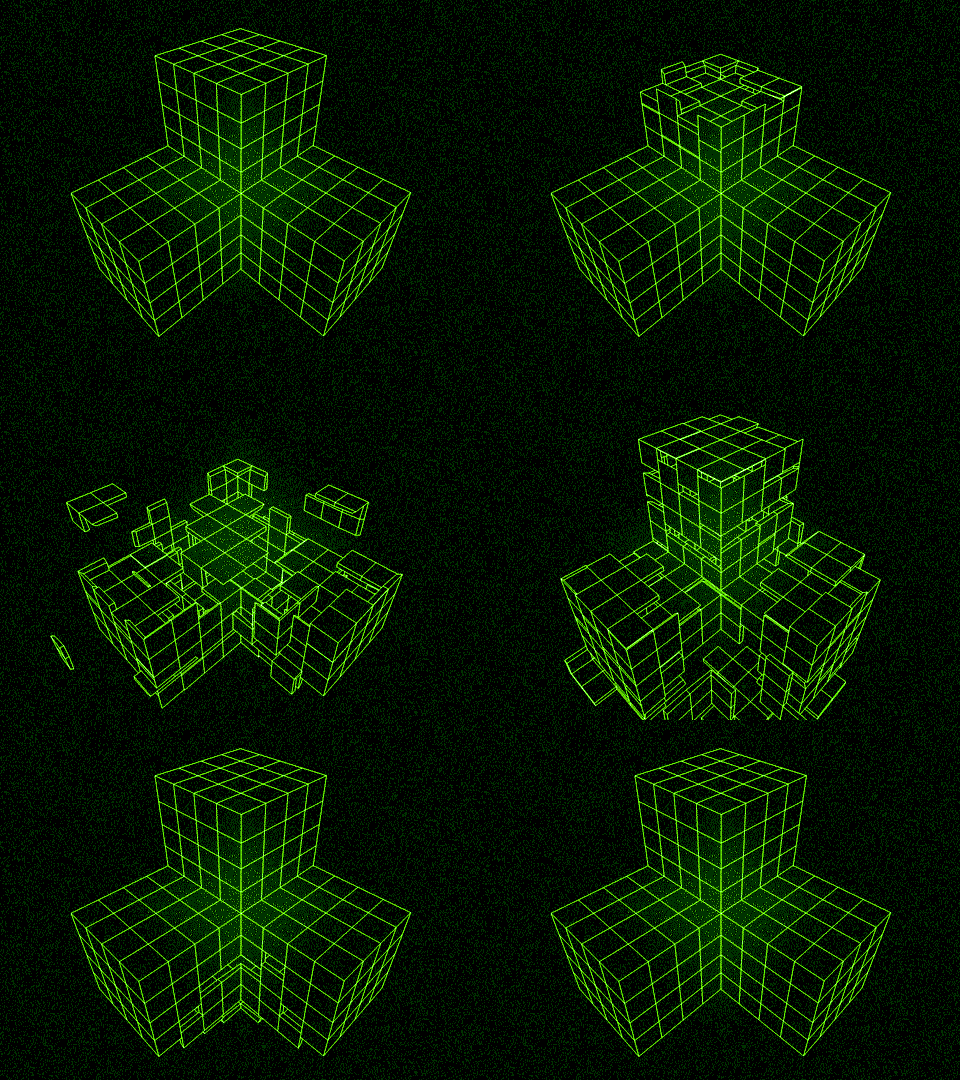
The Tetrahedron has four faces. OpenClaw’s four domains are content generation, visual media, marketing operations, and editorial output. Each face is a category of creative work; together they form the creative surface area of the Council. When a kanban card with `assignee: openclaw` reaches `ready`, it enters one of these faces.
## What OpenClaw is, technically
OpenClaw runs at port `:7077` as a Node-based agent gateway. It is a Hermes-compatible agent process — it reads the same config format, speaks the same A2A protocol, and shares the same kanban board as every other profile in the fleet. Its primary model is `opencode-go/mimo-v2.5` with a fallback to `opencode-go/deepseek-v4-flash`, configured through the same provider resolution that Hermes uses.
The critical architectural decision is that OpenClaw does not have its own filesystem tools. It calls OpenFang — the MCP server at `:7076` — for file I/O, web access, and browser control. OpenClaw is the creative engine; OpenFang is the tool access layer. This is the narrow-gate principle in action: OpenClaw’s output passes through OpenFang’s permission surface before touching the outside world.
OpenClaw currently runs 69+ plugins for specialized tasks. These are not general-purpose plugins — they are the creative toolkit: image generation via FAL.ai, media processing, content formatting, style application. Each plugin is a capability that OpenClaw routes to based on the task’s requirements. A “generate hero image” task routes to the FAL plugin; a “draft product copy” task routes to a text-generation plugin with brand voice context.
## A creative task, end to end
To make the profile concrete, walk one task. Hermes receives a request to produce a weekly Instagram batch for Lucid Hive’s shop. The orchestrator decomposes it into individual pieces: one hero image, three product photos, six caption texts, and a scheduling plan. Each piece becomes a kanban card assigned to OpenClaw.
OpenClaw claims the first card — the hero image. It reads the task from the kanban board (the same board S5.2 described), extracts the brief: a cypherpunk goth outfit with specific colors, a 16:9 aspect ratio, and the Lucid Hive brand style. It calls OpenFang via MCP to read the brand style guide from the vault. It then routes to its FAL.ai plugin, constructs a prompt that embeds the article title plus the brand’s dark neon cyan/violet palette, and submits it to the FAL API.
The image returns. OpenClaw does not write it directly to the filesystem — that would bypass the narrow gate. Instead, it writes the image to a temporary path and signals completion on its kanban card. The parent process (or a downstream worker) picks up the artifact, copies it to the vault, writes the provenance JSON, and publishes it to WordPress via docker-exec wp-cli. OpenClaw’s responsibility ends at the creative output; the logistics belong to the pipeline.
This separation is deliberate. OpenClaw is the *catalyst* — it produces the creative artifact. The *pipeline* handles storage, tagging, publishing, and indexing. Conflating the two is what produces agent systems where creative agents are also doing DevOps work, and vice versa. The Council keeps them separate because specialization is what makes the system scale.
## Why “catalyst” and not “generator”
The word matters. A generator produces output on demand. A catalyst *accelerates a reaction that was already possible* — it lowers the energy barrier, enables the transformation, but does not replace the underlying chemistry. OpenClaw does not replace human creative judgment; it lowers the energy barrier from “idea” to “published asset.”
In practice this means OpenClaw’s output always passes through a review layer before going live. The pipeline can auto-publish routine content (product descriptions with known templates), but campaign visuals, editorial pieces, and anything touching brand identity go through a human gate. The catalyst accelerates the process; the human confirms the result.
This is also why OpenClaw is not an “autonomous creative agent” in the way most frameworks describe the concept. It does not set its own goals. It does not decide what to create. It receives a task from Hermes (which received it from the orchestrator, which received it from the human operator), executes the creative transformation, and reports back. The autonomy is in the execution, not the intent. That distinction — creative autonomy without directive autonomy — is what makes OpenClaw safe to run at scale without producing off-brand content, unauthorized visuals, or creative drift.
## The plugin surface as creative capability
OpenClaw’s 69+ plugins are not a monolithic creative system. They are a modular capability set that grows as new creative tasks arrive. The FAL.ai plugin handles image and video generation. The brand-voice plugin maintains Lucid Hive’s editorial tone. The caption-optimization plugin generates social media text with hashtag suggestions. Each plugin is independently loadable, independently updatable, and independently replaceable.
This modularity matters because creative requirements change faster than infrastructure requirements. A new image model appears — swap the FAL plugin for a ComfyUI plugin. A new social platform launches — add a platform-specific caption plugin. The creative surface area expands without requiring changes to OpenClaw’s core gateway, its MCP integration, or its relationship with the Council.
The plugin architecture also means OpenClaw’s capabilities are *auditable*. Each plugin registers its tools with the gateway, and the gateway exposes those tools through OpenFang’s MCP surface. When a creative task routes to OpenClaw, the system can verify that the task’s requirements match the available plugins before claiming the task. A task that requires video generation but has no video plugin gets blocked at claim time, not at execution time. This is the same failure-early pattern that the kanban board uses for task lifecycle — the Council applies it to creative capability as well.
## OpenClaw in the Council hierarchy
OpenClaw is not standalone. It is Order 3 in the 9 Orders, beneath Hermes (Layer 0, the orchestrator), alongside OpenFang (Order 1, the gatekeeper) and ZeroClaw (Order 2, the DevOps core). Its children are ephemeral creative workers — content writers, image editors, caption generators — spawned through the same protocol S5.1 described. Its output is verified by the Oracle (Order 9) through the same signed-summary chain.
The Council chose this placement because creative work is the highest-volume, most repeatable task category in the system. A fashion brand produces dozens of content pieces per week. Each piece requires the same pipeline: brief → creative transformation → storage → publishing → indexing. OpenClaw is the node in the Council where that pipeline begins. It is the Fire that ignites the creative reaction; the rest of the Council carries it through to completion.
## The takeaway
If you are building a multi-agent system that produces creative output, three decisions separate a catalyst from a liability:
1. **Separate creative from logistics.** The agent that generates the image is not the agent that publishes it. The catalyst produces; the pipeline delivers.
2. **Route tools through a gate.** OpenClaw does not touch the filesystem or the network directly — it calls OpenFang via MCP. The narrow gate applies to creative agents as well as infrastructure agents.
3. **Make capability auditable.** Plugins register their tools; the gateway verifies before claiming. Creative tasks that exceed available capability get blocked early, not late.
OpenClaw is the creative catalyst because it does one thing well — transform intent into artifact — and trusts the rest of the Council to handle everything else. That trust is not assumption; it is architecture.
—
*Grounded in the wiki entity `openclaw` and concepts `council-of-three`, `the-9-orders`, `multi-profile-agent-architecture`, `narrow-gate-principle`, and the filed `lucidhive-wp-publish`, `comfyui`, and `creative-pipeline` skills. Continues the S5 series on the Council System after S5.2’s coverage of the shared kanban board. Design notes on a running system, not a sales pitch.*