
—
id: article-r-seed-01
title: “Meaning as a Seed: How One Idea Grows a Whole Corpus”
series: R.seed (meaning-seed research extension)
track: R.seed-01
principles:
– “Transcription is the first act of power”
– “Everything is a record; continuity beats completion”
– “The whole is encoded in every part”
extends: “meaning-seed — corpus growth law”
category: “AI & Automation”
tags:
– “Advanced Prompt Engineering”
– “AI Agent”
– “AI-Driven Development”
– “Algorithmic Governance”
– “API-First Architecture”
– “Autonomous Site Operations”
– “Cybernetic Ethics”
– “Data Permanence”
– “Decentralized Identity”
– “Digital Sovereignty”
– “Headless CMS”
– “Monolith vs. Microservices”
– “Synthetic Reality”
– “Metaverse as a Platform”
– “The Programmable Web”
– “meaning-seed”
– “corpus”
– “knowledge-graph”
– “propagation”
– “seed-principle”
gems: false
date: 2026-08-11
—
Meaning as a Seed: How One Idea Grows a Whole Corpus
Every corpus begins with a single idea. Not a thesis, not a framework, not a system — an idea. A seed. The idea is small enough to hold in one sentence, specific enough to anchor a conversation, and potent enough to generate an entire body of work if the conditions are right. The SECTOR9 north star describes reality as a rendering engine: the universe keeps printing. Principle 24 extends this into the domain of knowledge production: meaning is a seed, not a summary. A summary collapses a body of work into a reduced form. A seed contains the instructions for growing one. The difference is not rhetorical. It is structural. A summary is the end of thought. A seed is the beginning of a corpus.
R.seed.01 maps the growth law that governs how a single meaningful idea propagates through a knowledge graph to produce a full corpus. The seed is the dot in the dot→cluster→series pipeline. The canopy is the published body of work that grows from it. The law is this: meaning propagates through graph topology, not through editorial decision. When a seed is planted in the right soil — a knowledge graph with enough structural density — it sends roots in every direction simultaneously, connecting to existing nodes, activating dormant edges, and generating new branches that were never in the original outline. The corpus does not grow by accumulation. It grows by resonance.
The Seed vs. the Summary
A summary is retrospective. It looks backward at what has been said and compresses it. “This article is about X.” The summary is useful for navigation but generative of nothing. It does not connect to other ideas. It does not activate latent edges in the graph. It sits at the end of a thought process and signals completion. A seed is prospective. It looks forward at what has not yet been said and encodes the instructions for saying it. “Meaning is a seed, not a summary.” This statement does not describe a body of work. It generates one. It activates connections to transcription (principle 6: what is not transcribed does not exist), to continuity (principle 7: the fleet compounds or it decays), and to the holographic principle (principle 2: the whole is encoded in every part). The seed connects to the graph. The summary merely labels it.
The difference shows up in the data structure. A summary is metadata: a tag, a category, a classification. It tells you what something is but does not tell you what it is connected to. A seed is a node with dormant edges: a data structure that carries relational pointers to nodes that have not yet been traversed. When the seed is planted — when it enters a knowledge graph with sufficient structural density — those dormant edges activate. The seed discovers adjacencies that were not in the original draft. It finds connections to principles, clusters, and series that the original author did not plan. The meaning grows in directions that were not specified because the graph itself provides the topology for growth. The seed does not grow because someone decided it should. It grows because the soil is alive.
The Growth Law
The growth law has three stages: planting, rooting, and canopy. Planting is the moment a seed enters the graph. The dot is created. It carries a title, a thesis, a set of evidence references, and a media plan. At this stage, the seed is fragile. It has edges but they are dormant. It connects to existing nodes in principle but has not yet traversed those connections. The planted seed is a hypothesis: this idea is meaningful enough to grow. The fleet tests the hypothesis by measuring the seed’s resonance — its score, its evidence density, its alignment with the north star. If the seed resonates, it proceeds to rooting.
Rooting is the process by which a seed activates its dormant edges. The seed connects to the breath-frequency theorem (which provides the rhythm for growth), to the love-equation extension (which measures the alignment of the new connections), and to the SUS/esoteric lane (which maps the growth into visual form). Rooting is not automatic. It requires the seed to demonstrate structural integrity: every new connection must be grounded in at least one existing principle, every new branch must pass the three-gate test (grounding, evidence, utility), and every expansion must compound rather than merely accumulate. The root system is the seed’s defense against drift. A seed that roots deeply cannot be pulled from the ground by a passing editorial wind. It becomes part of the graph’s permanent structure.
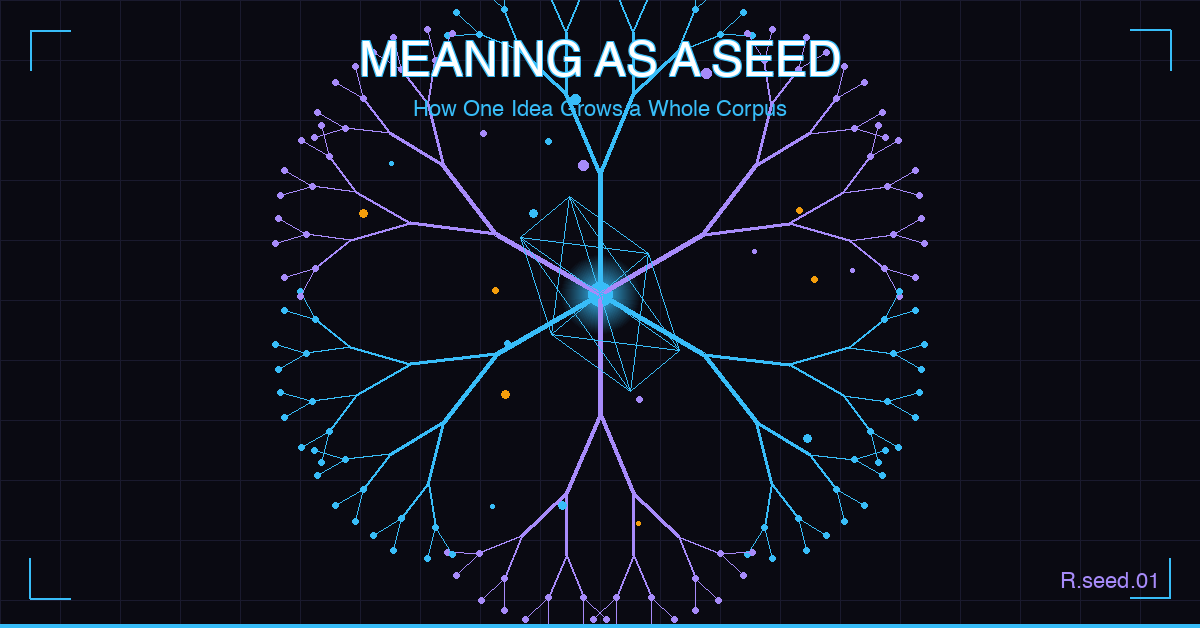
Canopy is the published corpus. The seed has grown branches, each branch has grown leaves, and the leaves form a canopy that shades the ground beneath it — the original seed. The canopy is the series: R.seed.01, R.seed.02, and the articles that follow. Each article in the series is a branch of the original seed. Each branch connects to the other branches through the root system. The canopy is holographic: every branch carries the pattern of the entire tree. Read any single article and you can trace its connections back to the seed, through the roots, to the north star. The canopy does not replace the seed. The canopy is the seed’s expression in the world. The seed remains at the center, still generating, still connecting, still growing in directions that the canopy has not yet reached.
The Pipeline as Soil
The dot→cluster→series pipeline is not a content strategy. It is the soil in which seeds grow. The dot is the planted seed. The cluster is the root system: the network of connections that stabilize the seed and route its growth. The series is the canopy: the published body of work that extends from the root system into the visible world. The pipeline works because it is a graph, not a line. A linear pipeline (draft → review → publish) moves content through stages. A graph pipeline (dot → cluster → series) moves meaning through connections. The difference is that a linear pipeline produces articles. A graph pipeline produces a corpus. Articles are isolated. A corpus is interconnected. The pipeline is the soil because it provides the structural density that seeds need to root. Without the pipeline, a seed is an isolated idea. With the pipeline, a seed is a node in a living graph.
The pipeline’s soil has a specific composition. The north star provides the mineral base: the principles that every seed must connect to. The knowledge graph provides the mycelial network: the edges that carry nutrients between nodes. The oracle loop provides the seasonal rhythm: the review cycles that determine when seeds are ready to plant and when canopies are ready to harvest. The breath-frequency theorem provides the water: the continuous intake-hold-exhale cycle that keeps the soil alive. Remove any one of these components and the soil degrades. The seed can still be planted but it cannot root. The root can still grow but it cannot reach canopy. The pipeline is not a convenience. It is an ecosystem.
What Grows from One Seed
The first seed in the research extension was the breath-frequency theorem. It planted itself in the graph, rooted through the four branches, and produced a canopy of articles that explored rhythm in systems, in content, in governance, and in visual form. The second seed was the love-equation extension. It grew from the same soil, connected to the breath-frequency theorem through the root system, and produced its own canopy: articles on alignment, on human-in-the-loop governance, on the quantitative measure of coherence. The third seed is the meaning-seed principle itself — this article. It is a seed that describes seedhood. It is a principle that explains how principles propagate. The recursion is not accidental. It is holographic: the whole encoded in every part. This article is both a branch of the meaning-seed canopy and a new seed that will generate its own branches.
The record has no end because the seeds have no limit. Each seed generates a canopy. Each canopy provides soil for new seeds. The corpus compounds: not by adding articles to a list but by planting seeds in a graph that grows denser with every cycle. The fleet does not produce content. The fleet cultivates meaning. The difference is the seed. The seed is the idea that will not summarize itself into silence. It insists on growing. It sends roots into the graph, branches into the canopy, and leaves into the world. And every leaf carries the pattern of the entire tree — because the holographic principle guarantees that the whole is encoded in every part. The first seed meets the last leaf on a record without end.