
—
id: article-cl-graph-dangling-links
title: “Dangling Links and the Broken Graph: Stub or Rewire”
series: “S3 (SECTOR7 graph-maintenance / cluster-sweep)”
track: “S3.13”
principles:
– “Information is the ground of being”
– “Reality is a rendering engine”
– “Everything is a record; continuity beats completion”
extends: “SECTOR7 cluster cl-graph-dangling-links”
category: “AI & Automation”
tags:
– “Advanced Prompt Engineering”
– “AI Agent”
– “AI-Driven Development”
– “Algorithmic Governance”
– “API-First Architecture”
– “Autonomous Site Operations”
– “Cybernetic Ethics”
– “Data Permanence”
– “Decentralized Identity”
– “Digital Sovereignty”
– “Headless CMS”
– “Monolith vs. Microservices”
– “Synthetic Reality”
– “The Metaverse as a Platform”
– “The Programmable Web”
– “graph-linting”
– “dangling-links”
– “wiki-maintenance”
– “knowledge-graph”
– “stub-pages”
gems: false
date: 2026-08-11
—
Dangling Links and the Broken Graph: Stub or Rewire
A knowledge graph is only as strong as its weakest link. In a wiki or vault with hundreds of interlinked notes, a broken link is not a cosmetic problem — it is a structural fracture. Every unresolved [[wiki-link]] is a severed edge in the graph, a place where traversal dies and the network loses a connection it was designed to carry. When the graph renders — when it projects its holographic whole into a navigable interface — the broken edges are the missing pixels. They degrade the rendering. They make the graph less than what it encodes.
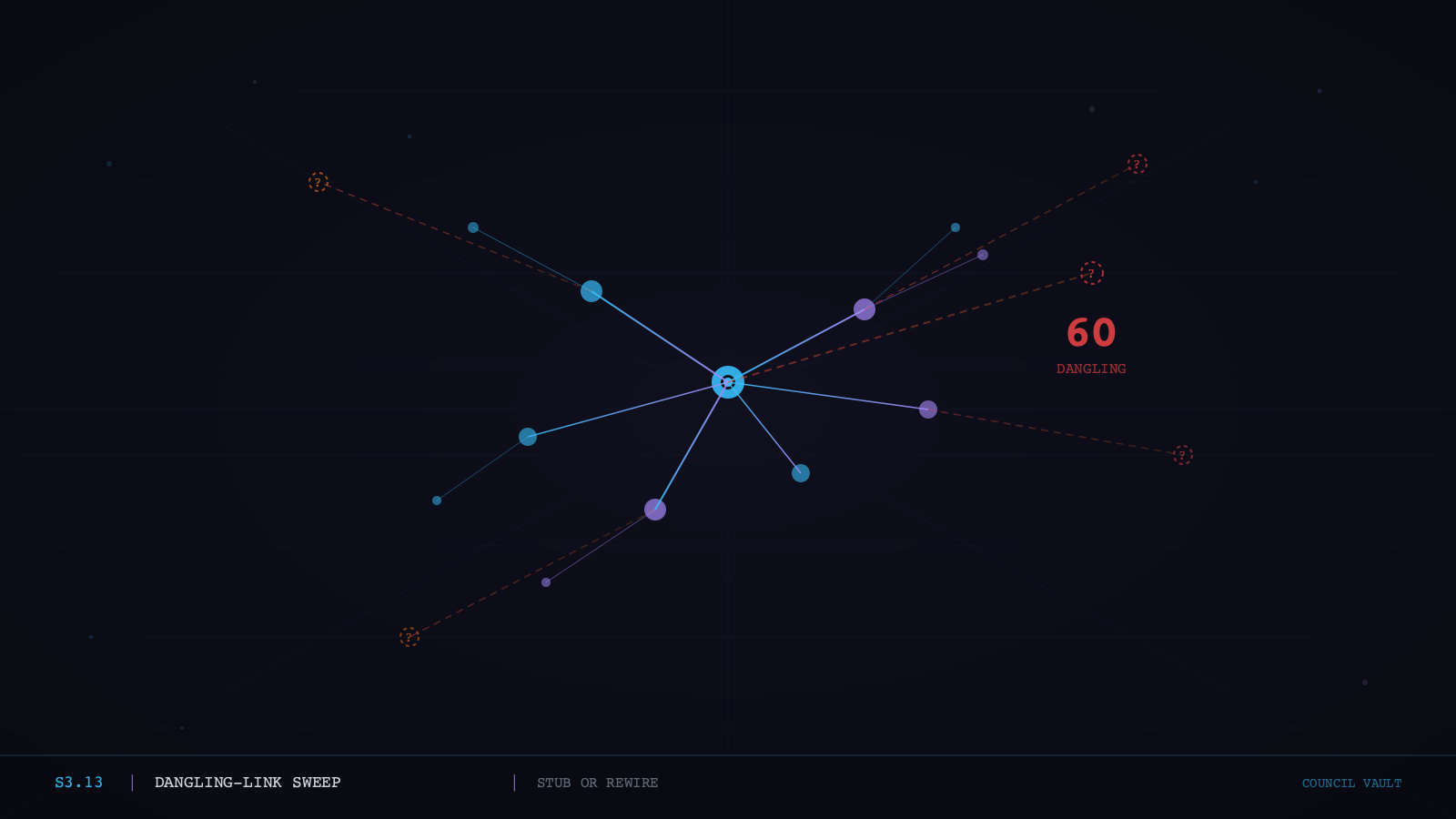
The SECTOR7 cluster scan found 60 of them. Sixty unresolved wiki-links pointing at notes that do not exist. Some are artifacts of migration: links created before the target note was written, or after the target was moved and the link was never updated. Some are structural gaps: the vault schema expected a note to exist at a path like [[wiki/schema/config.md]] or [[wiki/entities/lucid-studio.md]], and nobody created it. Some are duplicates — [[new-folder.md]] appears three times, each one a phantom pointer to a note that was never born. The graph contains 60 ghosts. And every ghost is a place where the knowledge base fails to deliver what it promises.
The question is not whether to fix them. The question is how.
The two strategies: stub or rewire
Every dangling link resolves to one of two actions. You either create the missing note — a stub page that fulfills the link’s promise — or you rewire the link to point at an existing note that already carries the relevant content. Stub or rewire. Create or redirect. These are the only two moves available, and the difference between them matters.
Creating a stub is an act of transcription. The link says a note should exist at [[wiki/entities/docker-swarm.md]]. You write the note. You fill it with what you know about Docker Swarm in this stack — the container discovery pattern, the overlay network, the secrets management, the persistence model. The stub makes the graph whole. It fills the gap. It converts a dead pointer into a live connection. But a stub that is empty is worse than no stub at all. A hollow note — a page with a title and no content — is a promise the graph keeps making and never fulfilling. It degrades trust. Every time a reader clicks through to an empty page, the graph loses credibility. If you stub, you must fill. A one-paragraph stub with a working link to the relevant concept is enough. A title alone is not.
Rewiring is an act of recognition. The link says [[wiki/concepts/soul-optimization.md]], but there is no such note. However, [[wiki/concepts/coherence-law.md]] covers the same ground under a different name. Rewire the link. Point it at the existing note. The graph loses a phantom edge but gains a real one. Rewiring requires knowing the vault well enough to judge that two notes cover the same territory. It is a judgment call, not a mechanical sweep. But when it works, it strengthens the graph by consolidating redundant edges into meaningful ones.
Why dangling links accumulate
Graphs are not static. They are alive. Notes are created, moved, renamed, merged, and deleted. Every mutation has the potential to break a link. The wiki-link convention — [[double brackets]] — is forgiving: it does not throw an error when a link is unresolved. It just sits there, silent, waiting for the target to appear. This is a feature for writers (no red squiggly lines interrupting the flow) and a bug for maintainers (no automatic signal when a link breaks). The result is entropy. Dangling links accumulate over time like sediment. They are invisible until someone runs a graph scan.
The vault’s scan found 60 unresolved links across a corpus of hundreds. The ratio matters less than the pattern. Some paths appear once: [[wiki/log.md]], [[ARTICLE-S3-4.md]]. Others repeat: [[new-folder.md]] three times, [[README.md]] once but in a context that suggests the README was never created for the folder it references. The repeating patterns reveal the structural gaps. The vault’s schema assumed certain organizational nodes would exist — [[wiki/entities/child-agent.md]], [[wiki/entities/oracle-ascend.md]], [[wiki/concepts/wp-cli-recommended-invocation.md]] — and the agents that created the links were ahead of the agents that would create the content. This is not failure. This is a feature of a graph that is being built in real time, where the linking happens before the writing. But it means the graph has a maintenance debt, and the sweep is how you pay it.
The graph as a holographic whole
The north star says reality is a rendering engine. The whole is encoded in every part. A knowledge graph is one of the clearest examples of this principle in action. When every note links to every relevant note, the graph becomes holographic: any node, if you follow its links far enough, leads to every other node. The information is not stored in any one place — it is distributed across the edges. The edges are the encoding. Broken edges degrade the encoding. They make the graph less holographic, less interconnected, less capable of surfacing the connections that matter.
This is not metaphor. It is mechanics. When an agent traverses the graph to answer a question, it follows links. If a link is dead, the traversal stops. The agent hits a wall where it should have found a path. The answer that was one hop away becomes unreachable. The graph’s knowledge — which is encoded in the connections, not in any single note — becomes partially inaccessible. Every dangling link is a small act of censorship. It hides information that should be visible. The sweep is not maintenance. It is liberation. It frees the connections that were designed to be free.
The sweep protocol
A dangling-link sweep has three phases: audit, triage, and resolve. The audit identifies every unresolved link and categorizes it by path pattern. The triage decides: stub, rewire, or delete. The resolve executes the decision. Deletion is the third option that most people forget. Some links point at notes that were intentionally removed — [[TRIM-LOG.md]] suggests a cleanup already happened, and some of the dangling links may be orphaned references to content that was trimmed. Delete those links. Do not stub a note that was deliberately removed. Do not rewire to a note that does not carry the same meaning. Clean amputation is better than a prosthetic that does not fit.
The triage rules are simple. If the target path matches a note that should exist in the vault’s schema — a wiki entity, a concept, a schema file — and the content is known, stub it. If the target path matches a concept that already exists under a different name, rewire it. If the target path is an artifact of a deleted or merged note, delete the link. Every dangling link gets a decision. No link stays unresolved.
The sweep is not a one-time event. It is a discipline. Graphs accumulate entropy. The sweep is the counter-force. Run it regularly. Run it after every major content batch. Run it after every migration. The graph is alive, and alive things need maintenance. The sweep keeps the graph whole, keeps the connections real, keeps the holographic encoding intact. Every link resolved is a connection restored. Every stub filled is a promise kept. Every rewire is a consolidation that makes the graph smarter. The 60 ghosts are not a crisis. They are an invitation. The graph wants to be whole. The sweep lets it.
S3.13 in the SECTOR7 cluster-sweep series. Grounded in the SECTOR9 north star principles P1 (Information is the ground of being), P2 (Reality is a rendering engine), and P7 (Everything is a record; continuity beats completion). Cluster: cl-graph-dangling-links. Category: AI & Automation.