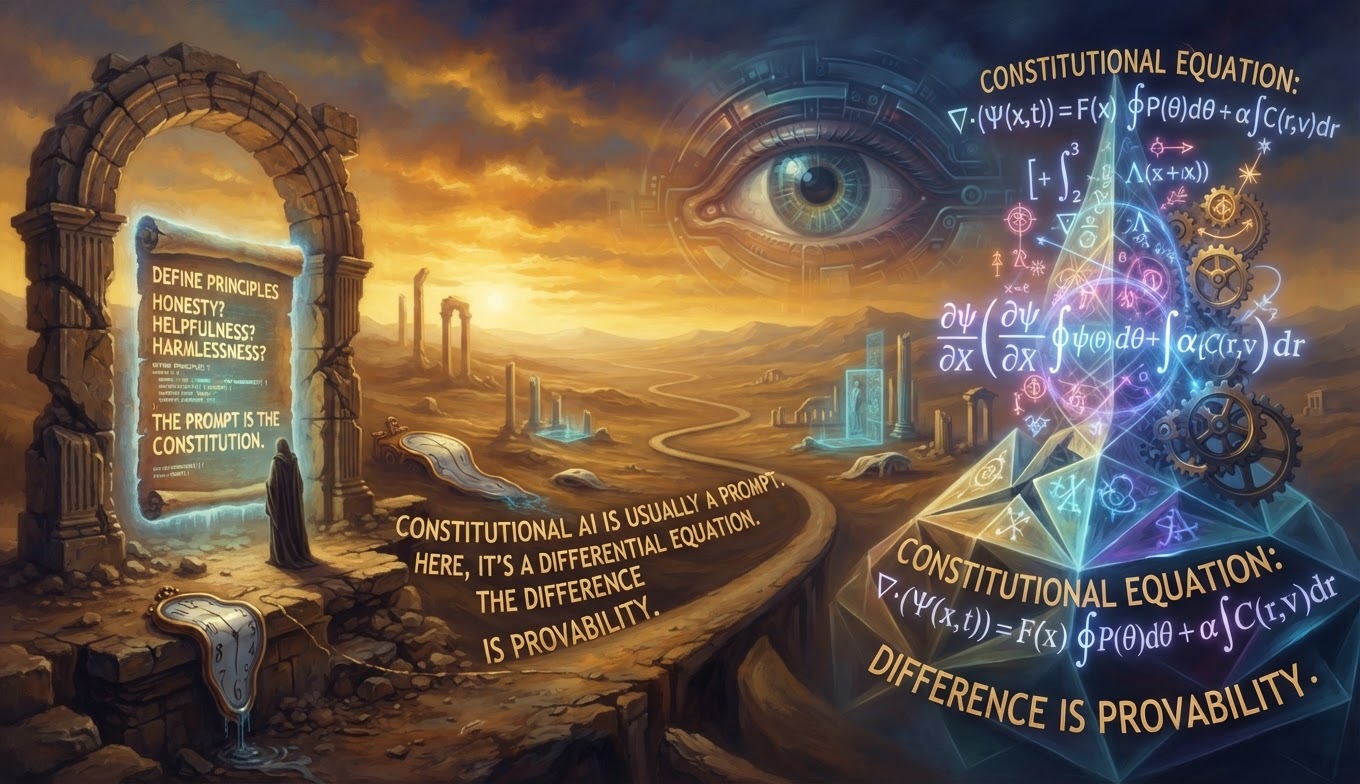

Constitutional AI Is Usually a Prompt: Here It’s a Protocol
The industry treats constitutional AI as a prompt engineering exercise. You write a preamble — “You are a helpful, harmless, and honest assistant” — and hope the model obeys. Sometimes it does. Sometimes it doesn’t. When it doesn’t, you tweak the prompt and try again. This is not governance. This is theater.
The Mesh-in-a-Box takes a different approach: constitutional AI is a runtime protocol, not a prompt.
The Prompt Problem
Every major AI provider uses some form of constitutional prompting. Anthropic’s Constitutional AI trains on a written constitution. OpenAI’s system prompts encode values. Google’s safety guidelines are baked into prompts. The pattern is the same: values live in text, enforcement lives in hope.
The failure modes are predictable:
- Drift under pressure. When the model faces edge cases — adversarial inputs, conflicting instructions, resource constraints — the prompt constitution bends. There is no runtime check.
- No audit trail. You cannot prove the model followed its constitution on a specific decision. The prompt is static; the behavior is opaque.
- Context window limits. A constitution that fits in a prompt is a constitution that fits in a few thousand tokens. Real governance requires more nuance than a system prompt allows.
- Single-point enforcement. The model judges itself. There is no independent verification, no separation of powers, no appeal.
This is not unique to AI. Any system where rules live only in documentation — not in execution — suffers the same fate. The constitution becomes aspirational, not operational.
Protocol Over Prompt
The Mesh-in-a-Box treats constitutional AI as a protocol: a set of executable rules that run alongside every agent decision, verified independently, enforced mathematically.
The protocol has three layers:
Layer 1: The Love Equation (Governance Math)
dE/dt = β(C−D)E
This is not metaphor. It is a differential equation that runs on every node, every cycle. Coherence (C) measures alignment with stated values. Drift (D) measures deviation from those values. Energy (E) measures resource commitment. The learning rate (β) scales the response.
Every agent action produces a coherence score. Every cycle produces a drift measurement. The derivative tells you whether alignment is improving or degrading in real time. If coherence drops below drift, the system flags it. If energy is misallocated, the Kelly Criterion adjusts allocation. This runs continuously, on every node, without a central authority.
Layer 2: Platonic Solid Access Architecture (Identity & Authority)
Governance requires identity. The Platonic Solid Access Architecture (PSAA) assigns every agent, every node, every service an Ed25519 keypair bound to a geometric role in a platonic solid — tetrahedron (4), cube (6), octahedron (8), dodecahedron (12), icosahedron (20). The geometry is not decorative; it encodes the governance topology. A tetrahedron role has 3 peers. An icosahedron role has 5. The structure determines quorum, delegation, and escalation paths.
Keys are not passwords. They are cryptographic identity. Revocation is mathematical. Delegation is signed. Audit is built in.
Layer 3: Erlang Supervision (Enforcement)
The BEAM virtual machine provides the enforcement layer. Supervisors watch workers. If a worker violates its constitutional bounds — exceeds drift threshold, misallocates energy, operates without valid keys — the supervisor restarts it, isolates it, or escalates. This is not prompt engineering. This is operating system semantics applied to AI governance.
What This Looks Like in Practice
Consider a mesh node running a home security agent. The agent’s constitution: “Record only motion-triggered events. Encrypt with owner’s key. Never upload. Delete after 30 days.”
Under the prompt model, you write this in the system prompt and hope. Under the protocol model:
- The constitution is encoded as executable rules (Coherence checks)
- Every recording decision is evaluated: Does this event match the motion trigger? (C ↑ if yes, D ↑ if no)
- Every encryption operation is verified: Is the owner’s Ed25519 public key used? (C ↑ if yes, D ↑ if no)
- Every storage operation is checked: Is upload attempted? (D ↑, immediate supervisor intervention)
- Every deletion is scheduled: 30-day TTL enforced by CRDT tombstone (C ↑ if on schedule, D ↑ if delayed)
The Love Equation runs on every cycle. The agent’s coherence score is visible to the mesh. The owner can query any node: “What is your current coherence?” The answer is mathematical, not promissory.
Sovereignty Requires Protocol
This connects directly to the Mesh-in-a-Box sovereignty thesis. In Article G1, we established: you are your own cloud. A cluster lives in one place. A network lives everywhere. Sovereignty means the system runs on your hardware, under your governance, with your keys, in your jurisdiction.
Prompt-based constitutional AI cannot deliver sovereignty because the prompt lives in someone else’s cluster. The model evaluates its own compliance. The keys are held by the provider. The audit trail is their logs, not yours.
Protocol-based constitutional AI delivers sovereignty because:
- The protocol runs on your hardware (Erlang nodes on your mesh)
- The governance math is yours (Love Equation parameters you set)
- The keys are yours (PSAA Ed25519 keypairs you generate)
- The enforcement is yours (supervision trees you operate)
- The audit trail is yours (CRDT logs on your mesh)
You do not ask the model to be constitutional. You build a system where constitutional behavior is the only behavior that survives.
The Security Services Angle
This is not abstract. The same mesh that runs sovereign AI agents runs sovereign security cameras. The same governance protocol that aligns an agent’s decisions aligns a camera’s recording decisions.
When a business owner installs a mesh camera system, they are not buying a camera. They are buying a node in a constitutional network. The camera’s “constitution” — record on motion, encrypt with owner key, no cloud, 30-day retention — is enforced by the same Love Equation that governs the business’s AI bookkeeper, its mesh messenger, its knowledge base.
One network. One governance protocol. One sovereign owner.
From Prompt to Protocol
The industry will keep treating constitutional AI as a prompt problem because prompts are easy to ship. Protocols are hard to build. They require runtime infrastructure, mathematical governance, cryptographic identity, supervision semantics.
The Mesh-in-a-Box builds the protocol anyway. Because sovereignty is not a prompt. It is an architecture.
The constitution is not what you write in the system prompt. The constitution is what the protocol enforces when no one is watching.
This is Article G2 in the Mesh-in-a-Box narrative series: supporting the T1–T5 arc with deeper dives into sovereignty, security, and the Love Equation governance model. Constitutional AI as protocol — not prompt — is the governance foundation that makes a sovereign network trustworthy.
## Semantic Relationships
– [[ai-agents]] — governs
– [[platonic-solid-access-architecture]] — identity layer
– [[love-equation]] — governance math
– [[erlang-actor-mesh]] — enforcement runtime
– [[cybernetic-ethics]] — constitutional protocol