
“Information becomes geometry, geometry becomes art.” — SECTOR9 North Star, public brand voice
A sovereign stack can be excellent at running its own systems and still be blind to the market around them. Local-first infrastructure, auditable records, and cloud-optional operations are strengths, but they do not automatically tell an operator what a competing stack is shipping, charging, or claiming.
Competitive sensing closes that gap. It is a standing practice of watching relevant signals, recording what changed, and making the change legible to the people who build and operate the system. A dashboard can display the results. It cannot create the discipline.
The goal is not to copy every competitor or predict every launch. The goal is to make surprise less likely. When a new feature, price change, or positioning shift appears, the operator should be able to say what happened, why it matters, and which response deserves a test.
Sensing is a discipline, not a dashboard
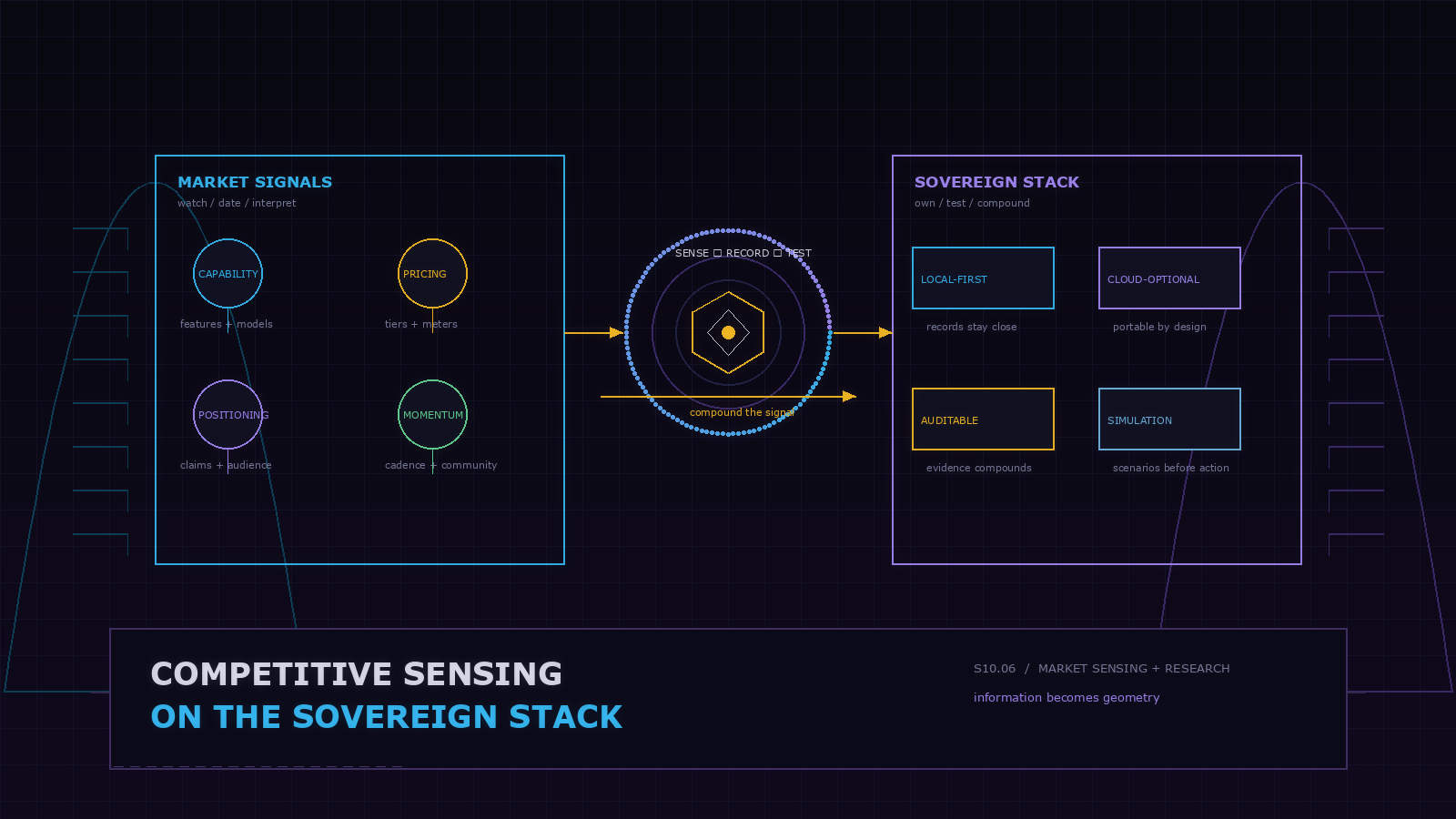
A useful sensing program watches four related layers.
- Capability: releases, integrations, model support, deployment changes, and new operational tools. A capability signal matters when it changes what a customer can do, not merely when a product page adds a new label.
- Pricing: tier changes, free-tier limits, usage meters, minimum commitments, and the boundary between self-hosted and managed offers. Pricing is often the first place a market change becomes concrete.
- Positioning: the language a competitor uses to describe ownership, autonomy, security, speed, and ease of use. Positioning reveals which problem the vendor believes it is winning.
- Momentum: release cadence, community activity, hiring patterns, documentation improvements, and public commitments. Momentum is a proxy, not proof, but a consistent change across several signals deserves attention.
None of these signals needs a complicated classifier. A dated capture of a changelog, a structured note from a pricing page, and a short assessment of why the change matters are often enough to begin. The first useful system is a disciplined record, not an elaborate model.
The self-contained blind spot
Sovereignty is partly the ability to continue when a third-party service disappears. That same independence creates a perceptual gap. An agent fleet running on your infrastructure does not encounter competing products unless someone points it at them. A research process that reads technical publications will not automatically read a vendor’s commercial announcements.
This is why competitive sensing cannot be treated as an occasional side quest. The operator needs a repeatable path from outside signal to inside decision. The path should be explicit, timestamped, and easy to inspect. If the only record is a person’s memory, the sensing system disappears when that person changes roles or the project becomes busy.
The practice also needs humility. A public pricing page is evidence of a stated offer, not proof that the product works as advertised. A feature announcement is evidence of direction, not evidence of adoption. A community metric is evidence of attention, not evidence of customer value. Good sensing keeps those distinctions attached to the record.
From signal to record
Each important observation should become a small, durable record. The useful fields are simple: the source, the capture date, the signal family, the change observed, the affected audience, the confidence level, and the next question.
That structure turns a browser session into institutional memory. Six months later, the team can ask not only what a competitor announced, but what was believed at the time, which evidence supported the belief, and which later event confirmed or challenged it. The record becomes more valuable as it ages.
The record should also preserve disagreement. One analyst may read a pricing change as a move upmarket; another may read it as pressure on a lower tier. Keeping both interpretations prevents a polished summary from erasing uncertainty. A later observation can resolve the disagreement, but it should not erase the earlier reasoning.
This is continuity without pretending that certainty arrived on schedule. The system learns from the sequence, not only from the latest page.
Feed the simulation
Competitive intelligence becomes operational when it can enter a simulation. A feature launch can become a scenario about customer demand. A price change can become a question about whether to match, differentiate, or change the boundary of an offer. A positioning shift can become a test of the language used in a landing page or sales conversation.
The simulation is not an oracle. It is a place to compare possible responses before the market forces a choice. The value is not in producing a single perfect prediction; it is in making assumptions visible and giving the team a prepared set of options.
The feedback loop should be continuous. A simulated response is only a hypothesis until the market supplies evidence. When the outcome arrives, attach it to the original scenario. A good sensing program therefore measures more than whether a competitor moved. It measures whether the organization noticed early, formed a useful interpretation, and learned from the result.
A working cadence
The smallest useful cadence is deliberately modest:
- Choose a small set of comparable stacks and the surfaces that matter most: changelogs, pricing, documentation, and one community signal.
- Run a weekly scan. Capture the source and the change, even when the change appears minor. A later comparison needs the baseline.
- Hold a short review when a signal crosses a threshold. The threshold can be simple: a meaningful capability, a pricing change, a repeated momentum signal, or a conflict with an internal assumption.
- Convert the review into scenarios and experiments. A record that never reaches a decision or a test is a curiosity, not intelligence.
- Close the loop. Mark the hypothesis as supported, weakened, or unresolved, and preserve the reason.
This cadence does not require a large research department. It requires a named owner, a stable place to write, and permission to say “we do not know yet.” Those three conditions do more for useful sensing than a large pile of alerts.
The moat is accumulated context
Technology can be copied. A dated history of observations, interpretations, experiments, and corrections is harder to copy because it is tied to a particular market and a particular moment. That history lets a team recognize a pattern sooner and avoid repeating a failed response.
The durable advantage is not secrecy. It is continuity. A sovereign stack can keep its records close, make its assumptions inspectable, and carry its learning forward even when the tools change. The result is not certainty about every competitor. It is a better chance of seeing clearly when the landscape moves.
North Star alignment
The SECTOR9 North Star says that information is the ground of being and that continuity beats completion. Competitive sensing expresses both principles in a practical cadence. Signals become information when they are captured; records become continuity when they remain available after the launch, post, or pricing page disappears.
The transmission principle matters too. One clear account of what changed, what it means, and what will be tested gives the whole fleet a signal it can act on. Vibe still matters, but it should travel with a source, a date, and a reason.
The smallest step is enough: watch one competitor, record one change, and test one response. Repeat. The map appears through the work.