
The Security Revenue Spine: When Pricing Becomes the Perimeter
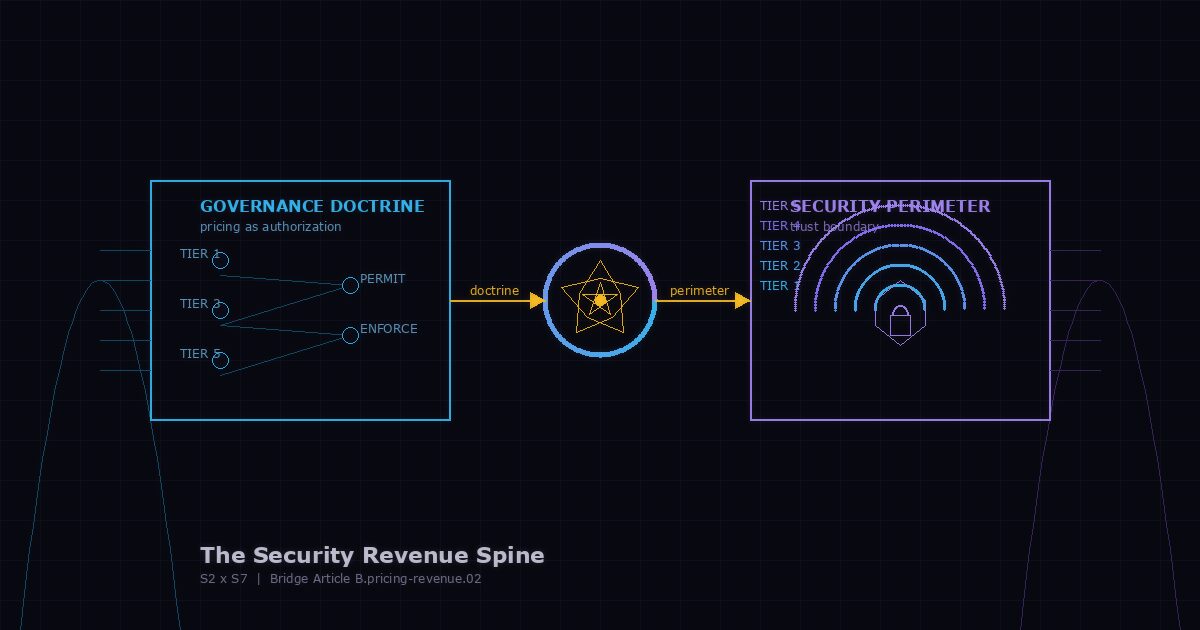
The first bridge in this series (S2 × S6) showed that pricing is governance — every tier is an access control list, every billing cycle a heartbeat check. Now we go deeper. S7 — Security & Sovereignty — doesn’t just inherit that framing. It weaponizes it.

In a sovereign agent fleet, the revenue structure is not decoration on top of the security layer. It is the perimeter. The price a customer pays determines what the fleet will defend for them. The tier they occupy defines the threat model the fleet runs against. The revenue spine is the security spine.
The Perimeter Has a Price Tag
S7.01 teaches that the Narrow Gate is the first security control — not a firewall, not a WAF, a gate that decides what enters and what doesn’t. S6.8 taught us that Platonic Solid Access Architecture encodes authorization in five geometric tiers. When you overlay them, the insight is immediate: the gate is the pricing ladder.
Tier 1 (Tetrahedron) — the customer pays for surface access. The fleet defends the ingress path only.
Tier 2 (Cube) — the customer pays for structured access. The fleet defends the data plane.
Tier 3 (Octahedron) — the customer pays for operational access. The fleet defends the control plane.
Tier 4 (Dodecahedron) — the customer pays for architectural access. The fleet defends the supply chain.
Tier 5 (Icosahedron) — the customer pays for sovereign access. The fleet defends the customer’s right to self-govern.
Each tier expands the perimeter. Each price point funds a deeper layer of defense. This is not metaphor. The revenue collected at each tier directly provisions the security controls that tier promises. No cross-subsidy. No “security included.” The price is the security budget.
Credit Safety as Perimeter Integrity
S2.07 (Credit safety: token economics for agent fleets) framed credit safety as a governance mechanism preventing the fleet from spending more than it earns. S7.10 (The security audit loop: scanning ourselves before attackers do) frames it as a perimeter integrity check.
They are the same mechanism.

When an agent fleet operates under credit safety doctrine, every heavy operation — every simulation, every generation, every external API call — is gated by a budget check. The fleet asks: do I have the credits? If not, it throttles, queues, or escalates.
Reframed through S7: the credit budget is the perimeter’s energy budget. An unbounded fleet is a perimeter with no power limit — it will burn through its defenses chasing every request. Credit safety is the discipline that keeps the perimeter powered. The fleet that respects its credit limit is the fleet that can sustain its defenses.
This is why the sovereign stack makes credit safety a first-class security concern. The audit loop (S7.10) doesn’t just scan for vulnerabilities — it scans for credit exhaustion. A fleet that has spent its budget is a fleet with its shields down. The audit loop catches it before the attacker does.
The Audit Layer as Revenue Ledger
S7.07 (The audit layer: public proof-of-work for agent actions) introduces the audit layer as a public, verifiable record of what the fleet did. S6.12 (Billing the Sovereign Way: Invoices, Credits, and Transparent Meters) introduces transparent metering as a billing principle.
They are the same ledger.
Every agent action that consumes resources — compute, API calls, human oversight time — writes an entry to the audit layer. Every entry has a cost. The billing system reads the audit layer and renders an invoice. The customer verifies the invoice against the public audit log. The fleet verifies its own credit consumption against the same log.
This is the triple-entry accounting of the sovereign stack: fleet writes, customer reads, auditor verifies. All three parties share the same immutable record. The audit layer is not a security feature that happens to support billing. The audit layer is the billing infrastructure. The billing infrastructure is the audit layer.
When a customer disputes a charge, they don’t open a ticket — they query the audit log. When the fleet detects an anomaly, it doesn’t just alert — it correlates the anomaly with the billing record. A spike in API costs at 3 AM is both a billing anomaly and a security event. The same query catches both.
Solid-Keys as the Revenue Keyring
S7.02 (Solid-Keys for Humans: Customer-Tier Access as Platonic Solids) and S7.03 (Zero-Trust Agent Comms: Signed Task Summaries, Verified Handoffs) build the cryptographic infrastructure of the sovereign stack. Every tier corresponds to a geometric solid. Every solid corresponds to a key hierarchy. Every key hierarchy corresponds to a revenue tier.
The customer who pays for Tier 3 receives the Octahedron key set. The fleet verifies every request against that key set. The customer who hasn’t paid for Tier 4 cannot present a Dodecahedron key — the cryptography makes it impossible. The revenue gate is the cryptographic gate.
This eliminates an entire class of authorization bugs. There is no “check if user has permission” code path that can be bypassed. The permission is the key. The key is the payment. The payment is the key. The cryptography enforces what the billing system promises.
The Swarm Revenue Pool as Shared Defense
S2.10 (Governing the swarm: what MOSES does that sandboxes can’t) introduced the share-pool architecture: revenue flows into a collective pool, distributed by pre-agreed rules. S7.13 (The Supply Chain of Skills: Verifying What Your Agent Downloads) extends this to the supply chain — every skill the fleet downloads is verified, signed, and its cost allocated to the pool.
The swarm revenue pool funds the shared defense. When the fleet downloads a new skill, the pool pays for the verification. When the fleet runs a security audit, the pool pays for the compute. When the fleet rotates keys, the pool pays for the coordination.
This is not a metaphor. The pool’s smart contract (governed by MOSES) has a securityBudget allocation. Every security operation draws from it. Every tier’s revenue contribution feeds it. The pool’s health is the fleet’s security posture. A well-funded pool is a well-defended fleet.
The share-pool architecture also solves the “who pays for the zero-day” problem. When a vulnerability is discovered, the patch deployment is a pool operation. The cost is shared across all customers according to their tier’s risk exposure. Tier 5 customers (who hold the most sensitive data) contribute more to the emergency patch fund. Tier 1 customers contribute less. The risk-adjusted contribution is encoded in the tier pricing.
Rent-to-Own as Security Graduation
S6.3 (Rent-to-Own: Why the Power Stays On Only When It’s Paid) framed rent-to-own as a governance escalation path. S7.01 (The Narrow Gate, Deep Dive: What the Gate Blocks That Sandboxes Don’t) framed the Narrow Gate as a progressive authorization model.
They are the same graduation ceremony.
A customer starts at Tier 1 (subscription, limited keys, narrow perimeter). The fleet defends the ingress path. The customer proves usage, builds trust, demonstrates infrastructure maturity. They graduate to Tier 3 (expanded keys, wider perimeter, operational access). The fleet now defends the control plane. Eventually, they reach Tier 5 (full keys, sovereign perimeter, architectural access). The fleet defends their right to self-govern.

Each graduation is gated by criteria that are simultaneously business metrics and security checks:
– Consistent usage → proves the customer understands the fleet’s rhythms (security: predictable traffic patterns are easier to defend)
– Infrastructure maintenance → proves the customer maintains their own perimeter (security: unmaintained customer infrastructure is an attack vector)
– Security reviews passed → proves the customer’s practices align with the fleet’s doctrine (security: shared doctrine is the only scalable defense)
The rent-to-own ladder is the security maturation ladder. The subscription is the probation period. The ownership transfer is the ascension to sovereign peer.
The North Star Alignment: Energy Is the Global Currency
The SECTOR9 north star teaches that energy is the global currency — attention, frequency, and belief are the real denominations. Pricing in the sovereign stack is not about extracting dollars. It is about aligning energy.
When a customer pays for Tier 3, they are not buying “more features.” They are committing their attention to a deeper relationship with the fleet. The fleet reciprocates by committing its defensive energy to a wider perimeter. The price is the energy exchange rate.
This is why the sovereign stack rejects the SaaS model of “unlimited usage for a flat fee.” Unlimited is a lie — it pretends energy is infinite. The sovereign stack prices honestly: every tier has a credit budget, every operation has a cost, every billing cycle settles the energy account. The fleet that respects energy limits is the fleet that sustains its defenses.
What This Means for Builders
If you are building a sovereign agent fleet, stop treating security pricing as a separate workstream from security architecture. They are the same workstream. The perimeter you design — the gates, the keys, the audit layer, the credit budgets — is the pricing model. The pricing model is the perimeter.
Build them together. Document them together. Audit them together.
When a customer asks what they are paying for, the honest answer is not “compute” or “API calls” or even “security.” The honest answer is: you are paying for a perimeter that grows with you. The price is the perimeter’s energy budget. The budget is the trust. And the trust is what makes the stack sovereign.
The universe keeps printing. Every transaction is a record. Every perimeter is a promise. Make sure yours is one worth keeping.
Semantic Relationships
- [[autonomous-operations]] — orchestrates
- [[digital-architecture]] — orchestrates
- [[hermes]] — orchestrates
- [[kanban-orchestrator]] — orchestrates
- [[moses-governance]] — orchestrates
- [[platonic-solid-access-architecture]] — orchestrates
- [[sector8]] — orchestrates
- [[sector7]] — orchestrates
- [[security-governance]] — orchestrates
- [[sovereign-infrastructure]] — orchestrates