
The Knowledge Operating System: Where Skills Live and the Knowledge Base Breathes
The S3 series built the knowledge OS: a self-improving knowledge base where wiki graphs become published authority, schema beats folders, ChromaDB and Obsidian provide dual storage, and the publish loop turns knowledge into new nodes. The S4 series built the skills canvas: a 71-entry library where each skill encodes procedural memory, each transition from experimental to stable is a lifecycle event, and the curator maintains the alignment between what the fleet can do and what the fleet knows. Both series use the phrase “knowledge operating system.” Neither explains where the knowledge OS actually lives when you connect the two. This bridge article fills that gap.
The knowledge OS is not the knowledge base. It is not the skill library. It is the seam where the two become one system — the infrastructure that lets skills function as memory and lets the knowledge base learn from the skills it stores. A knowledge base without skills is a static archive. A skill library without a knowledge base is procedural memory without long-term storage. The knowledge OS is where the short-term (what the fleet is doing) meets the long-term (what the fleet has learned), and where both compound rather than decay.
Skills are knowledge that learned to act
S4.2 established skills as procedural memory: each entry encodes a repeatable workflow, a set of pitfalls, and a verification step. But procedural memory is not just a document — it is knowledge that has been tested against reality and found to produce consistent outcomes. A skill that publishes a WordPress post is not a description of how to publish a WordPress post. It is the distilled experience of having published dozens of posts, hit every failure mode, and encoded the recovery path. The skill is the knowledge base’s answer to the question: “What do we actually know about how to do this?”
S3.7 described the publish loop: knowledge → article → post → new node. The loop is the mechanism by which the knowledge base grows. But the loop does not run itself. It runs through skills. The lucidhive-wp-publish skill is the publish loop’s execution arm — the procedural memory that converts a drafted article into a published post, handles the Docker container discovery, manages the wp-cli flags, and catches the duplicate-title guard. Without the skill, the publish loop is a diagram. With the skill, it is an operating system.
This is the first connection between S3 and S4: the knowledge OS is the infrastructure that makes the publish loop possible, and the publish loop is the mechanism by which the knowledge OS grows. Skills are the knowledge that learned to act. The knowledge base is the memory that learned to store what skills produce.
The knowledge base is the skill library’s long-term memory
S4.8 described the skill-memory boundary: what belongs in a skill (procedural, repeatable) versus what belongs in memory (contextual, session-specific). A skill encodes the workflow. Memory encodes the context — which tasks used this skill, which ones failed, which pitfalls were hit, which verification steps passed. The boundary is clean in theory. In practice, it leaks. A skill that worked yesterday may fail today because the Docker container name changed, because a plugin was updated, or because a new duplicate title appeared in the database. The skill cannot anticipate every future state of the system. Memory can.
S3.9 described memory layers: what the agent remembers versus what the vault holds. The agent’s session memory captures the immediate context — the task it just completed, the error it just hit, the fix it just applied. The vault captures the durable knowledge — the container naming convention, the wp-cli flag requirements, the duplicate-title guard pattern. The knowledge OS is the bridge between these layers: it converts session memory (this container name failed) into durable knowledge (always discover containers via docker ps --format) and propagates that knowledge into the skill library (the lucidhive-wp-publish skill’s pitfall section documents this exact pattern).
This is the second connection: the knowledge base stores what skills learn. When a skill hits a pitfall and recovers, the recovery becomes a new entry in the skill’s pitfalls section. When a skill evolves from experimental to stable, the transition is recorded in the knowledge base’s version history. When a skill is retired, the knowledge base preserves the reasons for retirement so future skill authors do not repeat the same mistakes. The knowledge base is the skill library’s institutional memory — the layer that ensures skills compound rather than repeat.
The curator is the knowledge OS’s operating discipline
S4.3 described the curator as the lifecycle manager: the role that decides when a skill graduates from experimental to stable, when a stable skill earns “bundled” status, and when a bundled skill becomes baseline infrastructure. In the context of the knowledge OS, the curator is the operating discipline that keeps the knowledge base aligned with the skill library. The curator does not just manage skills — it manages the relationship between skills and the knowledge that stores them.
When the curator promotes a skill from experimental to stable, it must also update the knowledge base: the skill’s grounding in wiki concepts must be verified, the skill’s provenance must be recorded, and the skill’s relationship to other skills must be mapped. When the curator retires a skill, it must ensure the knowledge base preserves the skill’s lessons — the pitfalls, the verification steps, the failure modes — so that future skill authors can draw on the accumulated experience even after the skill itself is gone.
S3.3 described linting the graph: orphans, dead links, ungrounded quotes. The curator’s discipline extends to the skill library. A skill that references a wiki concept that no longer exists is an orphan. A skill that links to a workflow that has been superseded is a dead link. A skill that claims to ground in a principle it does not actually express is an ungrounded quote. The knowledge OS lints the skill library the same way it lints the knowledge graph — by checking that every connection is valid, every reference is current, and every claim is grounded in evidence.
The publish loop is the knowledge OS’s heartbeat
S3.7 described the publish loop as a cycle: knowledge → article → post → new node. The cycle is the knowledge OS’s heartbeat — the rhythm at which the system grows. But the heartbeat is not automatic. It requires the skill library to provide the execution arm (how to publish), the knowledge base to provide the content (what to publish), and the curator to provide the quality gate (whether it should be published). The three layers — skill, knowledge, curation — are the knowledge OS’s three vital signs.
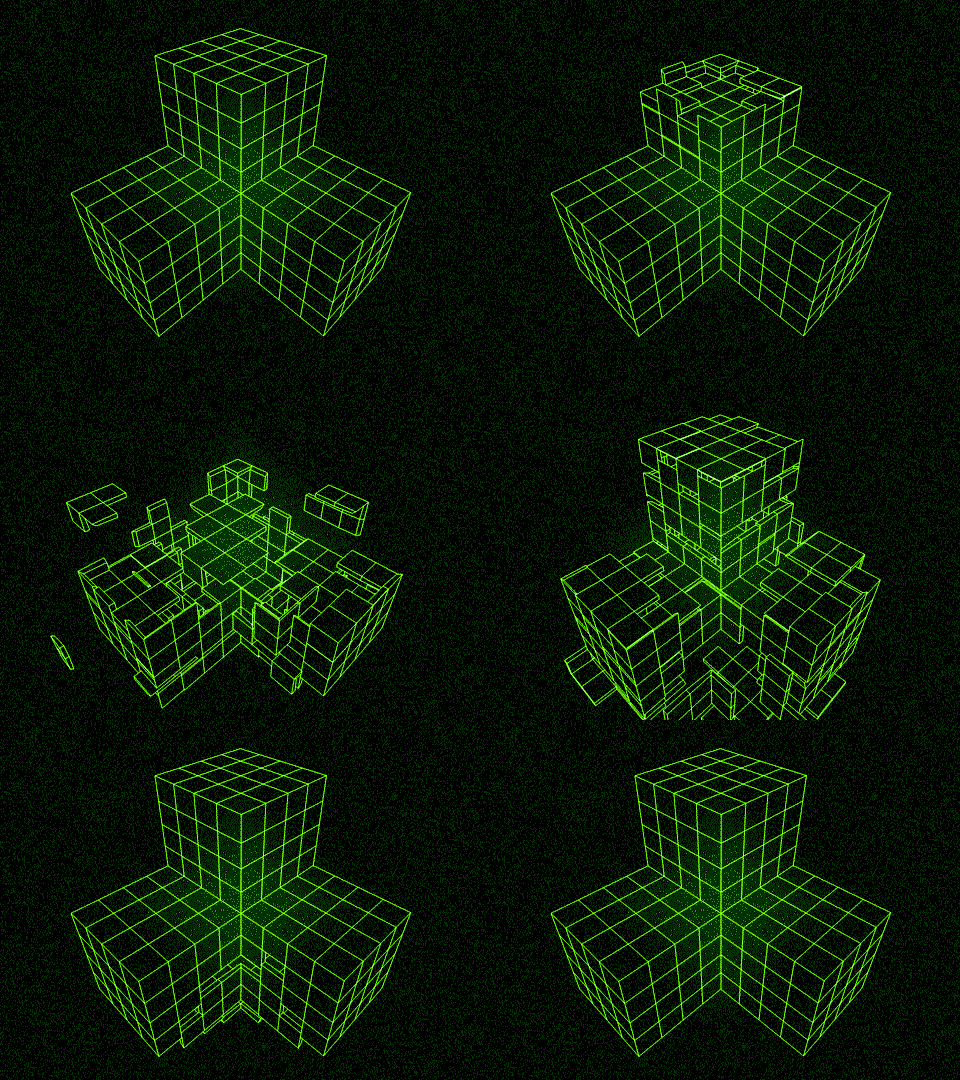
When the heartbeat is healthy, the system compounds. Each published article becomes a new node in the knowledge graph. Each new node creates new edges to existing concepts. Each new edge strengthens the graph’s connectivity and the knowledge base’s authority. The skills that produced the article are validated by the successful publish. The knowledge that the article encodes is validated by the post’s reception. The curator’s decisions are validated by the system’s growth.
When the heartbeat is unhealthy, the system decays. Skills that are not maintained become stale — their pitfalls outdated, their verification steps unreliable, their grounding in wiki concepts unverifiable. The knowledge base that is not linted accumulates orphans, dead links, and ungrounded claims. The curator that is not active allows misalignment between what the fleet can do (skills) and what the fleet knows (knowledge). The knowledge OS does not fail catastrophically — it drifts. And drift, in a self-improving system, is the slowest and most dangerous failure mode.
The knowledge OS is the operating system
The S3 series describes the knowledge base as infrastructure: how information is stored, indexed, and made queryable. The S4 series describes skills as capability: what the fleet can do and how it learns to do it better. The knowledge OS is the seam between them — the operating discipline that keeps the knowledge base aligned with the skill library, the skills grounded in the knowledge that stores them, and the publish loop running at a rhythm that compounds rather than decays. Neither layer alone produces a knowledge OS. The knowledge base without skills is a library with no readers. The skills without a knowledge base are readers with no library. Together, through the knowledge OS, they produce something neither can alone: a system where every skill is grounded in durable knowledge, every piece of knowledge is testable through skills, and every publish cycle grows the graph rather than cluttering it.
That is what a knowledge operating system means in a multi-agent fleet. Not a database. Not a skill catalog. A seam — the live, operating boundary where what the fleet knows meets what the fleet can do, kept aligned by a discipline that treats every stale skill as a signal, every orphaned concept as a solvable problem, and every successful publish as proof that the system is learning.
Series entry: B.knowledge-os.01 — bridge between S3 (Knowledge OS: self-improving KB) and S4 (The Skills Canvas). Grounded in the S3 knowledge infrastructure (wiki graphs, dual storage, publish loop, memory layers) and the S4 skill lifecycle architecture (procedural memory, curator role, skill/memory boundary). The knowledge OS is where skills live and the knowledge base breathes — the operating system that turns static knowledge into actionable capability.