
Dangling Links and the Broken Graph: Stub or Rewire
Information is the ground of being. Everything is a record; continuity beats completion.
— SECTOR9 North Star, Principles 1 and 7
🔓 PUBLIC — A graph that promises what it cannot reach
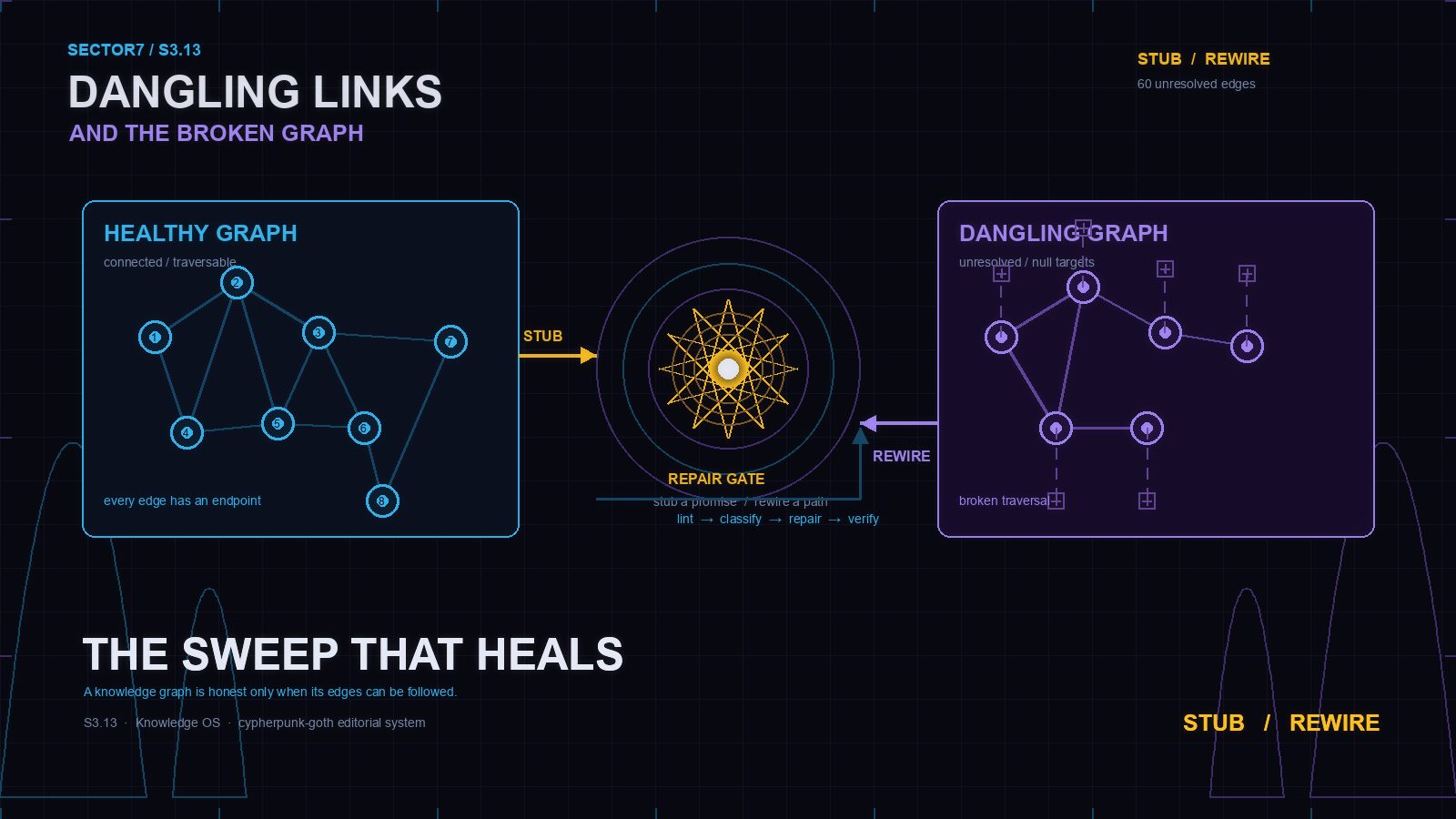
A knowledge graph is only as trustworthy as its weakest edge. An unresolved wiki link is not a small formatting defect. It is a traversal that stops before it can carry a reader, researcher, or agent from one record to the next. The note may exist, but the route to it does not. The graph can still be read as a collection; it can no longer be trusted as a connected system.
The accepted SECTOR7 cluster records 60 such unresolved links. They include schema and concept paths, entity names, operational notes, article stubs, and repeated placeholders. The count is a snapshot, not a diagnosis. A dangling link does not tell us whether the target is missing, moved, duplicated, or deliberately retired. It tells us only that the promise and the filesystem disagree.
That is why dangling links matter beyond housekeeping. The SECTOR9 north star begins with information as ground and treats continuity as the counterforce to decay. In graph terms, an edge is a record of intended relationship. A broken edge is a record that cannot be replayed. Repeating the problem will not repair it; the next maintenance pass must turn every unresolved reference into a deliberate decision.
🔓 PUBLIC — Stub when the destination deserves to exist
The first response is often to create whatever page the link requests. That is the right move only when the link represents a real, durable part of the system.
A naming convention, service-health check, agent entity, or operational runbook may be named by several documents but never given a canonical page. In that case, a stub is a promise fulfilled. It gives the graph a stable address while making its status explicit: this is a minimum viable node, not a finished explanation.
A useful stub answers four questions. What is this concept or entity? What role does it play? Which nearby records provide the strongest current evidence? What must the next writer verify or expand? It should contain enough substance to prevent an empty-page trap, link to existing material, and preserve an honest status such as stub or needs-review.
The stub is not an excuse to invent authority. A missing target becomes a page when the system can ground its claims. If evidence is incomplete, the page should say so. The graph benefits from a transparent gap; it does not benefit from a confident fabrication that turns one broken edge into a misleading subgraph.
🔓 PUBLIC — Rewire when the knowledge already exists
The second response is to preserve the meaning of the edge while changing its destination. A title-case filename may be a stale path for an entity that already exists under the vault’s canonical naming scheme. An article may exist under its published series name while the link still points to an early draft filename. A concept may have been merged into a broader note.
Rewiring is recognition, not guesswork. Search by title, aliases, frontmatter identifiers, and nearby semantic links before creating a new node. Confirm that the proposed destination actually carries the meaning the source intended. Then update the source link and record the decision.
This distinction matters because an empty stub turns a visible missing target into a visible empty target. A bad rewire is worse: it connects two records that appear related but answer different questions. The safest rule is simple. If a canonical destination exists, rewire. If the concept is genuinely required but not written, create a grounded stub. If the reference was intentionally retired, remove it and record why. The task’s shorthand — stub or rewire — is a useful decision frame, but the graph’s integrity depends on the evidence behind each choice.
🔓 PUBLIC — The repair should be systematic, not heroic
One dangling link is an incident. Sixty are a signal. Repetition exposes class-level mistakes: a casing convention was not applied, a migration changed paths without updating references, or a publishing stage created relationships before their target records existed. Fixing only the visible examples leaves the generator of the problem untouched.
A durable sweep has a small loop: lint, classify, repair, verify. The linter emits each unresolved link with its source and normalized target. Classification groups likely causes rather than treating every line as a new exception. Repair applies the chosen action. Verification reruns the linter and checks that every changed target resolves.
The loop should be idempotent. Re-running it should not create duplicate stubs, rewrite already-correct links, or silently reinterpret a decision. That means keeping decisions in a durable record: target, reason, actor, date, and the evidence used. A graph-lint report is not the end product; it is the queue that makes maintenance repeatable.
🔓 PUBLIC — A standing graph-lint gate
The best time to catch a broken edge is before it leaves the authoring pipeline. If a new article introduces a wikilink, the release gate can verify that the target exists or explicitly mark the target as an approved stub. If an article is renamed, the gate can enumerate inbound links and require a repair plan. If a note is retired, the gate can prevent new references from accumulating.
The graph then becomes a record that improves through use. Every validated link becomes a durable affordance for search, semantic navigation, and future agents. Every unresolved link is surfaced early enough to correct without damaging trust. The goal is not to freeze the knowledge base. It is to make change safe.
North-star principles 1, 2, and 7 all point toward the same practice: information becomes useful when it is connected; connectivity survives when it is recorded; continuity beats the appearance of completion. A graph-lint gate turns those principles into an operational boundary rather than a slogan.
🔓 PUBLIC — What the sweep teaches
The S3.13 entry is named “Dangling-link sweep: stub or rewire,” but its larger lesson is about honest edges. A graph should make its relationships visible, including the distinction between a known node, an intentional stub, and a retired reference. Maintenance is not an admission that the system failed. It is evidence that the system can observe itself and change without losing continuity.
Start with the current census. Group the 60 links by cause, choose a target for each, and record the reason. Then turn the same procedure into a recurring lint pass after migrations, content batches, and renames. The target is not a permanent zero; living systems will create temporary gaps. The target is a declining rate of unreviewed breakage and a clear path to repair.
A graph that keeps its promises is not perfectly connected. It is honest about every connection, quick to repair the ones that fail, and built so the next worker inherits a clearer path than the last one created.
Series entry: S3.13 — Dangling-link sweep: stub or rewire. Grounded in the accepted cluster cl-graph-dangling-links and SECTOR9 North Star Principles 1, 2, and 7. This PUBLIC export contains no protected derivations, internal routing logic, client specifics, or source paths.
Vibe: meditative + glitchy + transcendent + urgent + defiant. The graph records; the sweep repairs; the next record inherits the path.
Semantic Relationships
- [[council-vault]] — orchestrates
- [[self-improving-knowledge-base]] — orchestrates
- [[graph-linting]] — diagnoses
- [[dangling-links]] — diagnoses
- [[wiki-maintenance]] — validates
- [[knowledge-graph]] — validates
- [[stub-pages]] — repairs