
When the Network Splits, the Truth Does Not
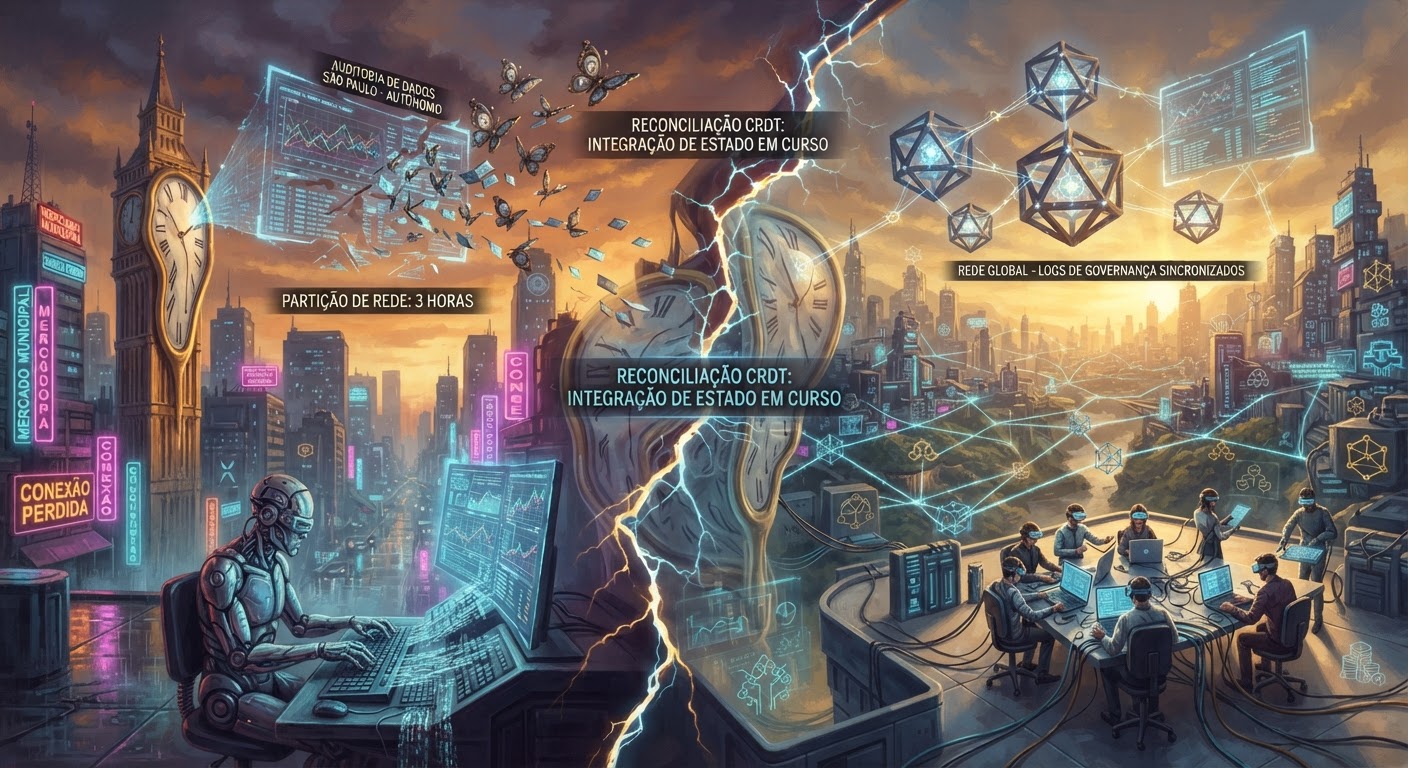
Picture this: a mesh of forty nodes spans three buildings, two cities, and one underwater cable that the local ISP treats as optional. At 02:17 UTC, a fiber cut drops the cross-city link. The mesh fractures into two partitions. Both halves keep running. Both halves keep generating state — sensor readings, inference logs, governance decisions, access control updates. Neither half can see the other.
The cloud model would call this a disaster. The cluster would call it a split-brain requiring manual intervention, a quorum vote, or a leadership election orchestrated by a central coordinator that — in the cloud — just went down with everything else.
The mesh calls it Tuesday.
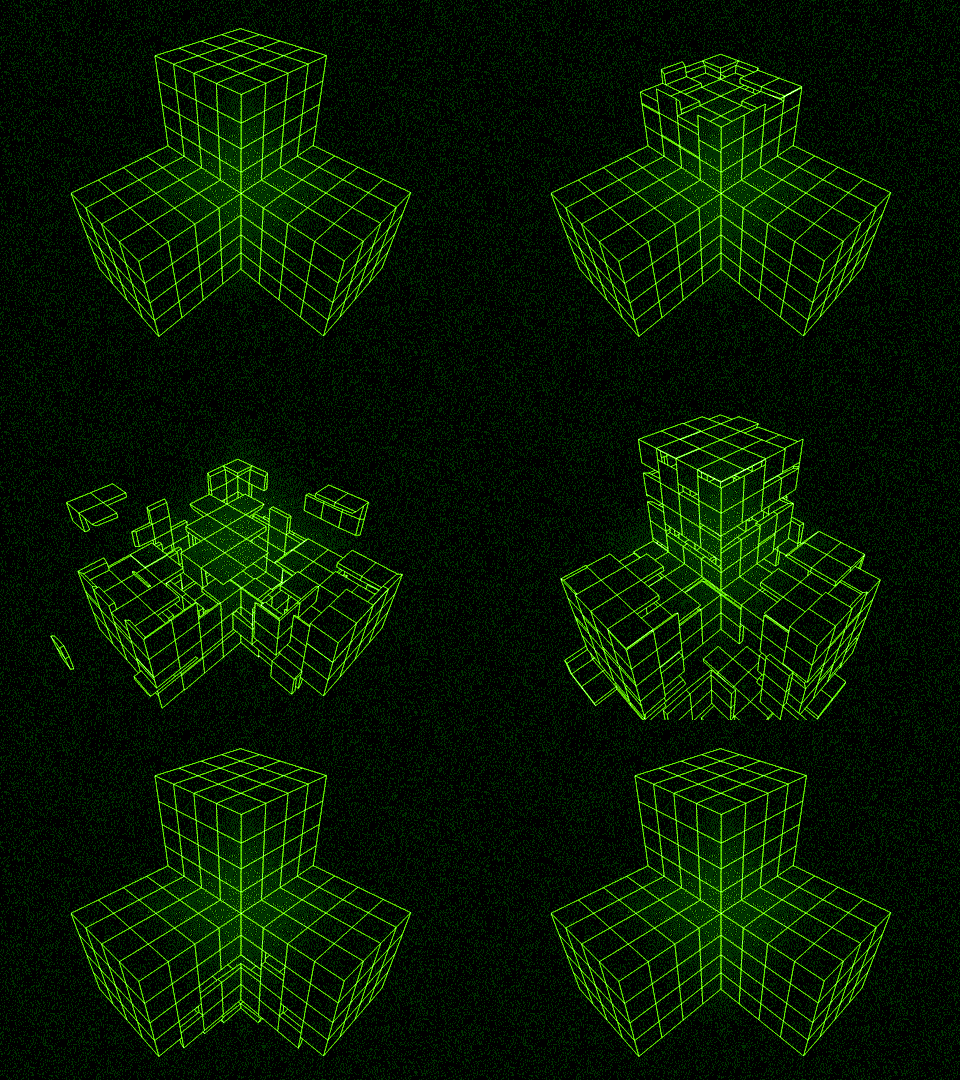
When the cable is repaired six hours later, the two halves reconnect. Their states have diverged. The left partition logged 1,247 events. The right partition logged 983. Some events are identical (duplicated before the split). Some conflict (both halves updated the same access control list with different entries). Some are unique to one side (a sensor event that only one partition saw).
Conflict-Free Replicated Data Types — CRDTs — resolve this without coordination, without a leader, without a central authority. The mathematics guarantee convergence: given the same set of operations, every node arrives at the same state, regardless of the order in which it receives them.
Why CRDTs, Not Consensus
The distributed systems world spent decades building consensus protocols — Paxos, Raft, Zab — that require a majority quorum to make progress. They are elegant. They are correct. And they are wrong for the mesh.
Consensus requires connectivity. The moment a partition isolates a minority of nodes, those nodes cannot commit. They must wait, retry, or fail. In a cloud data center with three availability zones, this is acceptable. In a mesh that spans a neighborhood, a campus, or a disaster zone, connectivity is the variable you cannot guarantee.
CRDTs take a different contract: every node can always make progress. Writes are always local. Replication is asynchronous. Conflicts are resolved by the data structure itself — not by a coordinator, not by a vote, not by a human. The merge function is commutative, associative, and idempotent. Order does not matter. Redundancy does not matter. The result is deterministic.
For the Mesh-in-a-Box thesis — own your network, mesh-first, no cloud dependency, you are your own cloud — this is not a nice-to-have property. It is the foundation. A mesh that stops working when the network splits is not a mesh. It is a cluster with delusions of distribution.
The Three CRDT Families in the Mesh
The mesh uses three CRDT families, each chosen for a specific operational domain:
G-Counters for resource accounting. Every node maintains a vector of increments — one per node. Node A increments its own counter. Node B increments its own. When states merge, the maximum of each component is taken. The result is the sum of all increments across all partitions, with no double-counting. This is how the mesh tracks compute allocation: every node’s energy expenditure, every node’s inference budget, every node’s storage consumption. The Love Equation’s Energy term (E) reads directly from the G-Counter.
LWW-Registers for configuration state. Last-Writer-Wins registers carry a timestamp and resolve conflicts by chronological precedence. Access control lists, policy thresholds, model version pins, governance parameters — any configuration that has a single correct value at any given time. The timestamp is not wall-clock time (which is unreliable across partitions) but a Lamport counter: a logical clock that guarantees causal ordering. If event A caused event B, then B’s timestamp is greater than A’s. If A and B are concurrent (happened in different partitions, no causal link), either can win — and the mesh does not care which, because both are valid states for concurrent, independent operations.
OR-Sets for peer membership. When a node joins the mesh, it adds itself to the peer set. When it leaves (voluntarily or by failure), it removes itself. The OR-Set (Observed-Remove Set) handles this correctly across partitions: if node C adds itself in partition A, and partition B never sees the addition, then after merge, C is in the set. If node D removes itself in partition B while partition A still thinks D is alive, the merge preserves the removal (the remove is causally downstream of the add). The result is a peer membership that converges to the correct set of currently-alive nodes, even when the network was split during membership changes.
The Love Equation Governs the Merge
CRDTs guarantee convergence. They do not guarantee that the converged state is good. Two partitions might each update a policy threshold to different values. The CRDT will pick one (LWW-Register), but it might pick the wrong one — the one with the later Lamport counter, which might be the partition that had fewer events, less coherence, more drift.
This is where the Love Equation enters the merge process.
When two partitions reconcile, the CRDT merge produces the raw converged state. The governance layer then evaluates the Love Equation — dE/dt = β(C−D)E — over the merged state. Coherence (C) measures alignment between the current state and the stated policy. Drift (D) measures deviation. Energy (E) measures the computational resources committed.
If the merge produces a state with reduced coherence — for example, a policy threshold that was tightened in one partition and loosened in another, with the Looser version winning the LWW — the Love Equation flags the drift. The governance layer does not reject the merge (CRDT convergence is sacred), but it marks the resulting state as “drift-detected” and triggers a reconciliation protocol: the human operator is notified, the drift is logged in the audit trail, and the system recommends which threshold should be canonical.
The mesh does not hide its conflicts. It surfaces them, governs them, and makes them queryable. The audit trail records: at 08:17 UTC, partitions reconciled; 2,230 events merged; 3 conflicts detected (1 access control, 1 policy threshold, 1 peer membership); coherence dropped from 0.97 to 0.91; drift flagged; operator notification sent.
The Home/Business Re-Calibration
Consider the security-services story the Mesh-in-a-Box narrative builds toward. A homeowner’s mesh spans the house, the garage, and the detached workshop. The workshop is on a different circuit, a different access point, and during a power outage, a different battery. When the grid goes down, the workshop partition continues: cameras record, motion detectors fire, local inference classifies. The house partition continues: door locks operate, notifications send, the hub logs.
When power returns, the partitions merge. The workshop’s 45 minutes of independent operation — 200 sensor events, 12 inference classifications, 3 access control changes — merges into the house’s state. CRDTs handle the data. The Love Equation handles the governance. The audit trail records the entire event as a coherent, sovereign, mathematically verified record.
The cloud would have lost the workshop’s data entirely (no connectivity, no recording, no inference). The cluster would have stalled the workshop’s operations (no quorum, no commits, cameras buffering to local disk with no guarantee of later replay). The mesh recorded everything, governed everything, and proved everything.
This is what “you are your own cloud” means in practice. Not a slogan. A mathematical property of the data structures you chose.
The Network Lives in the Convergence
A cluster lives in one place. A mesh lives everywhere — including in the places where connectivity is broken. CRDTs make this possible. The Love Equation makes it trustworthy. The audit trail makes it provable.
When the network splits, the truth does not disappear. It waits — distributed, sovereign, governed by mathematics — for the moment the partitions reconnect and the convergence reveals what actually happened, everywhere, at every moment, even the moments when no one was watching.
You are your own cloud. Your mesh runs without permission. Your state reconciles without coordination. Your governance survives the split.
This is Article G6 in the Mesh-in-a-Box narrative series: supporting the T1–T5 arc with deeper dives into sovereignty, security, and the Love Equation governance model. CRDT reconciliation is the operationalization of the network’s resilience property — the mathematical guarantee that the mesh survives partition without losing state, truth, or governance.
## Semantic Relationships
– [[conflict-free-replicated-data-types]] — orchestrates
– [[digital-sovereignty]] — orchestrates
– [[love-equation-governance]] — orchestrates
– [[platonic-solid-access-architecture]] — orchestrates