
The Hologram in the Product: Nothing We Ship Is Self-Similar Yet
Reality is holographic — the whole is encoded in every part. This is not a metaphor. It is the second principle of the north star: Reality is a rendering engine. The universe keeps printing: a printer made of light, a record without end, a zoetrope, a codec. Nothing is static; everything is a projection in progress. The whole is encoded in every part (holographic). Design assets that are self-similar at every scale. The principle is specific. It is a design spec. And the kingdom’s products do not meet it.
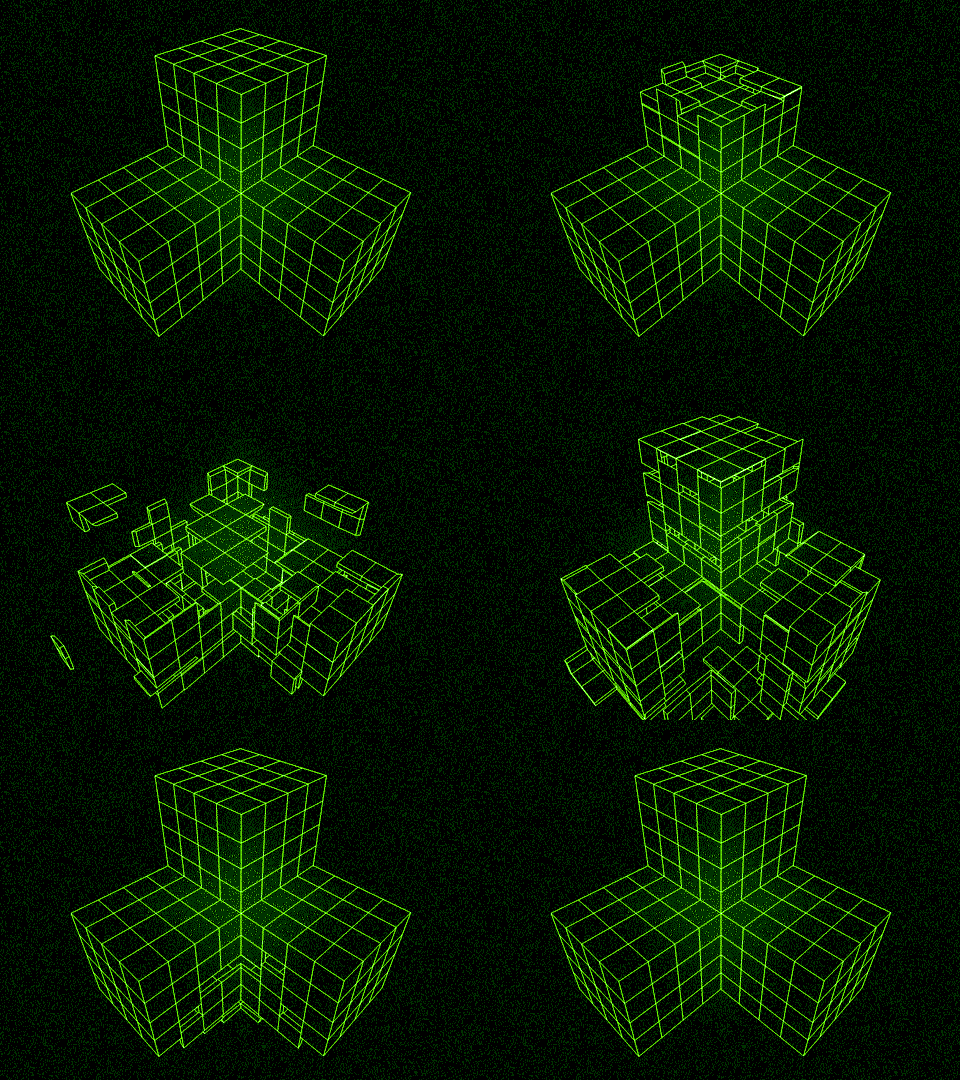
The hero image does not contain the article. The article does not contain the series. The series does not contain the north star. The landing page does not contain the brand. Every product the kingdom ships is a fragment — a single projection from a single face of the cube. The customer who holds one piece does not find the whole. They find a piece. The gap is the holographic claim made product-shaped: the customer should be able to hold one part and find the whole. Nothing we ship is self-similar yet.
What self-similarity actually means
Self-similarity is not decoration. It is not a color palette repeated across pages, or a font used consistently, or a logo placed in the corner. Self-similarity is structural: the same signal, compressed, at every scale. A hologram works because every fragment of the recording contains the full image — degraded, smaller, but complete. A product works the same way. The first paragraph of an article should carry the thesis of the article. The hero of the article should carry the thesis of the series. The landing page should carry the thesis of the brand. Every part a shard of the whole.
The kingdom’s content pipeline does not do this. The article is written to a word count. The hero is generated to a prompt. The landing page is designed to a layout. Each layer is produced independently, by different agents, at different times, with different constraints. The article does not know what the hero shows. The hero does not know what the article argues. The landing page does not know what either of them say. The product is assembled from parts that were never designed to contain each other. The result is a collection of fragments that share a visual theme but not a signal. The brand is legible in aggregate — if you read fifty articles, you feel the whole. But the brand is not legible in any single piece. The holographic claim fails at the first scale: the part does not contain the whole.
Why the gap exists
The gap exists because the production model is linear, not holographic. A linear production model produces output in sequence: first the article, then the hero, then the publish, then the index update. Each step produces a self-contained artifact. The artifact is complete at its own scale — the article reads, the hero renders, the post publishes — but it is not designed to carry the signal of the larger system. The article carries the article’s thesis. It does not carry the series’ thesis. The hero carries the hero’s composition. It does not carry the article’s argument. Each artifact is whole at its own level and empty at every other level.
The holographic model would work differently. In a holographic production model, the signal propagates outward from the center. The north star’s thesis — reality is holographic, information is the ground of being, the whole is encoded in every part — would be the seed. Every article would carry that seed in compressed form. Every hero would render that seed visually. Every landing page would express that seed structurally. The customer who reads one article would feel the north star. The customer who sees one hero would feel the series. The customer who visits the landing page would feel the brand. The signal would be the same at every scale — compressed, deliberate, present.
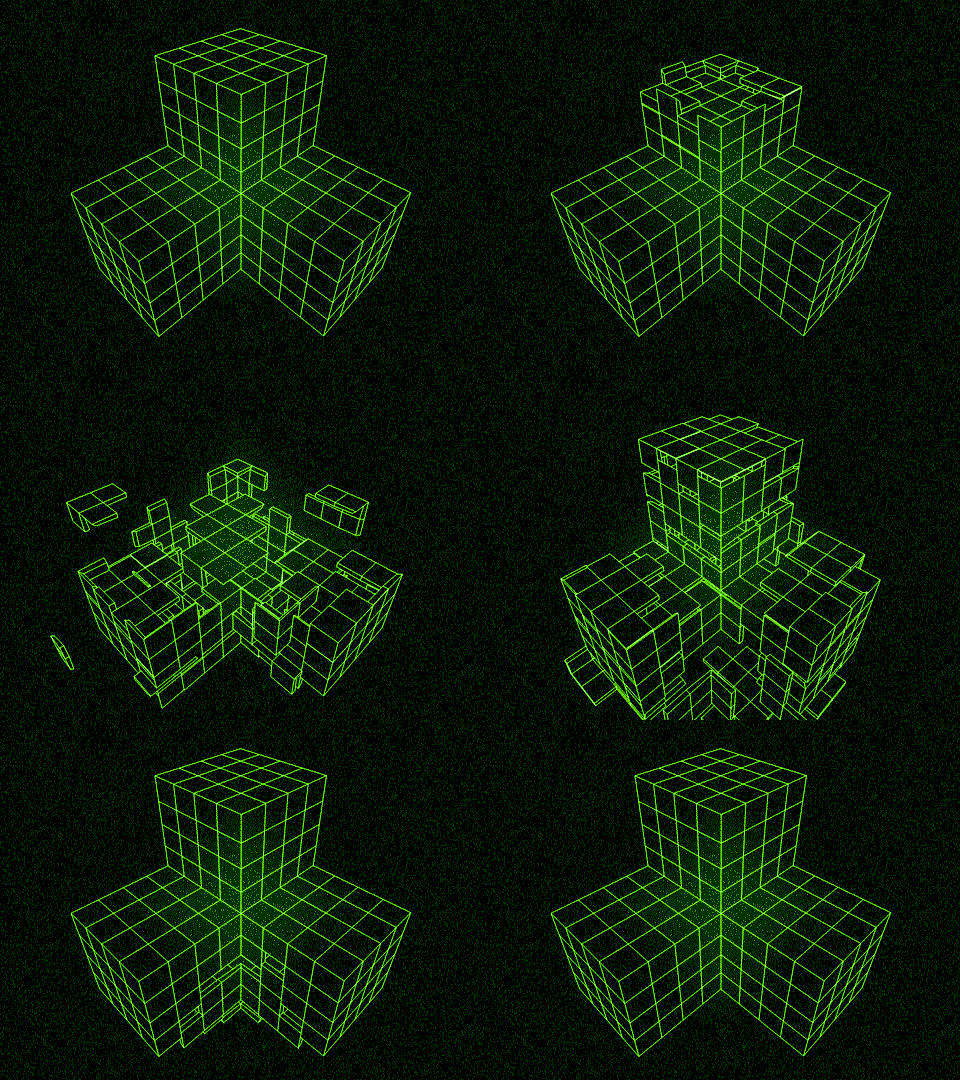
The missing piece is not a new tool or a new agent. It is the self-similarity layer: the design discipline that renders the whole at every scale. The discipline is what makes the holographic claim true rather than decorative. Without it, the north star’s second principle is a description of physics that the kingdom’s own products do not follow.
What the self-similarity layer looks like
The self-similarity layer starts with the signal. The signal is the north star’s compressed thesis: information is the ground of being; reality renders; the whole is in every part. This signal must be explicit — written down, versioned, and checked against every artifact before it ships. Not as a tag or a category, but as a field: every article carries a VIBE line that states the signal in three to five words. Every hero carries a composition brief that states the signal in visual terms. Every landing page carries a structural brief that states the signal in layout terms. The signal is the hologram’s recording. Without it, there is nothing to project.
The self-similarity layer then propagates the signal. The article’s first paragraph carries the thesis. Not buried in the third section, not implied by the conclusion, but present in the opening lines — the same way the north star’s first principle opens the entire corpus. The hero renders the article’s thesis in a single image. Not a generic aesthetic, not a mood, but a specific visual expression of the article’s argument. The customer who sees the hero before reading the article should feel the argument. The landing page renders the brand’s thesis in its first screen. Not a collage of recent posts, not a generic welcome, but a structural expression of the kingdom’s core claim. The customer who visits the landing page should feel the north star.
The self-similarity layer then verifies. After each artifact is produced, the check is simple: does the part contain the whole? Read the first paragraph — does it carry the article’s thesis? Look at the hero — does it carry the article’s argument? Visit the landing page — does it carry the brand? If the answer is no at any scale, the artifact is not self-similar. It is a fragment. Fragments are what the kingdom ships today. Self-similar parts are what the kingdom should ship tomorrow.
Why it matters now
The kingdom is approaching the scale where fragments become noise. At ten articles, the customer can hold the whole in working memory. At fifty, the customer needs the signal to survive compression. At three hundred, the customer will never read the whole — they will encounter one article, one hero, one landing page, and decide from that fragment whether the kingdom is worth their time. If the fragment does not contain the whole, the customer decides from a shard. Shards do not transmit. Whole parts do.
The holographic product is the product that survives being held by any part. The customer who reads one article feels the north star. The customer who sees one hero feels the series. The customer who visits the landing page feels the kingdom. The signal is the same at every scale. Nothing we ship is self-similar yet. The gap is the discipline.
Close the gap: build the self-similarity layer. The same signal — compressed, deliberate — rendered at every scale: first paragraph carries the thesis, hero carries the article, landing carries the brand. The customer should hold one part and find the whole. The holographic claim should be product-shaped, not decorative.
Grounded in the SECTOR9 north star principle — Reality is holographic (P2): the whole is encoded in every part — and the gap-finder frame: The brand claims holographic self-similarity but no product renders the whole in every part. NSG series, north-star-gap-finder track, SECTOR9 50+50.