The Horizon Is a Relationship: We Treat Boundaries as Barriers
The horizon is not a line where the world ends. The horizon is a relationship — the place where the sky and the earth negotiate what they share. The corpus is precise on this point: singularity and horizon are not opposites separated by distance; they are partners bound by a contract of interaction. The boundary between them defines what crosses, how it is verified, and what is recorded. The boundary is alive. The boundary is a relationship.
The kingdom quotes this principle. The kingdom builds walls.
The gap-finder frame asks: where does the kingdom treat a relational boundary as a barrier? The answer is: everywhere the fleet draws a line between inside and outside, between tiers, between access levels, between customer and system, between one agent’s territory and another’s. Every boundary in the kingdom is built as separation. The corpus says the boundary is a relationship. The kingdom builds walls where the corpus builds contracts.

The wall-boundary
A wall separates. A wall says: this side is here, that side is there, and the two do not meet. A wall does not negotiate. A wall does not carry terms. A wall does not remember what crossed it or why. A wall is the absence of relationship — a dead boundary that functions by blocking instead of by defining.
The kingdom’s boundaries are walls. The tier gate blocks access until payment clears, then opens and stays open until payment stops. The tenancy barrier isolates customer data so thoroughly that one customer’s world cannot see another’s, cannot reference another’s, cannot learn from another’s. The access control layer draws a line between authorized and unauthorized, between authenticated and unauthenticated, between the fleet’s interior and the world outside. Every boundary is a wall. Every wall is a dead boundary.
The wall-boundary has a property the fleet does not examine: it decays. A wall that only separates becomes less useful over time because the contexts on both sides evolve and the wall does not. The tier gate that opened at payment time does not renegotiate when the customer’s usage shifts. The tenancy barrier that isolated data at onboarding does not relax when the customer would benefit from cross-tenant signals. The access control line that was drawn at authentication time does not redraw itself when the agent’s role changes. The wall stands. The contexts move. The wall becomes a barrier in the original sense — something that impedes rather than something that defines.
The relationship-boundary
A relationship defines how two spaces interact. A relationship carries terms: what crosses, under what conditions, with what accountability. A relationship is maintained — actively, continuously, with attention. The terms are the relationship’s rules. The audit trail is its memory. The boundary does not block; the boundary negotiates.
The corpus’s singularity-horizon example is precise. The singularity is the center — the concentrated point where all information converges. The horizon is the expanding edge — the place where the system meets the world. The boundary between them is not a wall that keeps the center separate from the edge. The boundary is the relationship that defines how the center feeds the edge and how the edge informs the center. The boundary is the negotiation between concentration and expansion. The boundary is alive because the negotiation is continuous.
The kingdom’s equivalent is the customer boundary. The customer’s world and the system’s world should be bound by terms, not separated by walls. The terms define: what data crosses from customer to system (input), what data crosses from system to customer (output), what is verified at the crossing point (authentication, authorization, validation), and what is recorded about the crossing (audit trail, provenance, logs). The boundary is the contract. The contract is the relationship. The relationship is alive because the terms are maintained.

The gap: dead boundaries everywhere
The fleet’s boundaries are dead in three specific ways.
First, the boundaries carry no terms. The tier gate opens or closes. It does not define what the customer may do at each tier, what data flows at each level, what the system promises at each access point. The gate is a wall. The wall has no contract. The customer crosses the wall and enters a space with no defined relationship.
Second, the boundaries are not maintained. The tenancy barrier was drawn at onboarding and never redrawn. The access control line was set at authentication and never renegotiated. The boundary is set once and stands indefinitely, even as the contexts on both sides evolve. A relationship that is not maintained is not a relationship — it is a memory of a relationship, decaying in place.

Third, the boundaries do not record. The audit trail at the boundary is sparse — who crossed, when, whether access was granted. The trail does not record why the boundary was drawn where it was, what terms were in effect at the time of crossing, or how the boundary has changed since the last crossing. The boundary has no memory. A relationship without memory is a wall.
Closing the gap: relational boundary design
The fix is not to remove boundaries. The fix is to make every boundary a relationship. Every boundary carries its terms — what crosses, how it is verified, what is recorded — and is maintained like a relationship: actively, continuously, with attention.
The implementation has three parts. First, every boundary gets a contract. The tier gate does not just open or close — it defines the terms of access at each tier: what data flows, what the system promises, what the customer may do. The tenancy barrier does not just isolate — it defines the terms of isolation: what can cross for shared signals, what remains private, what is verified at the crossing point. The access control line does not just authenticate — it defines the terms of the relationship: what the agent may access, for how long, under what conditions, with what audit trail.
Second, every boundary gets a maintenance cadence. The terms are reviewed periodically. The boundary is redrawn when contexts evolve. The relationship is tended like a relationship — with attention, with renegotiation, with the understanding that the boundary serves the spaces it connects, not the walls it prevents.
Third, every boundary gets a memory. The audit trail records not just who crossed but what terms were in effect, why the boundary was drawn where it was, and how the boundary has changed. The boundary remembers. The relationship compounds. The wall does not remember because the wall is dead. The relationship remembers because the relationship is alive.
The kingdom’s north star says the abyss is a room, not a wall. The abyss is the boundary. The room is the habitable space inside the boundary — the space where the relationship lives, where the terms are negotiated, where the crossing is verified and recorded. The wall is the dead boundary — the separation, the block, the barrier that does not remember and does not maintain. The fleet that quotes the principle without practicing it lives behind walls. The fleet that practices relational boundary design lives in rooms.
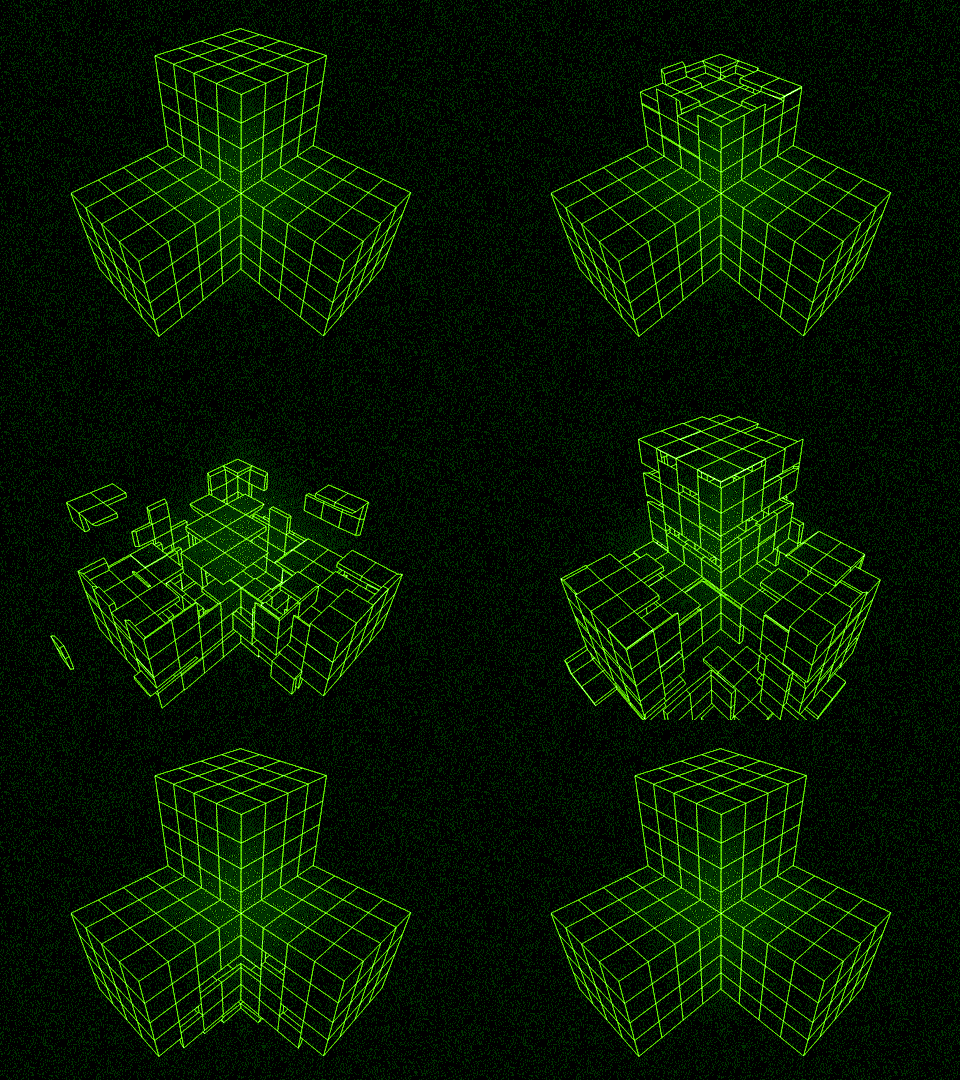
Close the gap. Build relational boundaries. Every boundary carries its terms, is maintained like a relationship, and records its history. The horizon is a relationship — the kingdom’s boundaries should be relationships.
Grounded in the SECTOR9 north star principle P12 — The abyss is a room, not a wall — and the gap-finder frame: The corpus defines boundaries as relational contracts; the kingdom builds them as separation walls. NSG series, north-star-gap-finder track, NSG-C, SECTOR9 50+50.