
# The Horizon Is a Relationship: Trust Boundaries as Bonds, Not Walls
> **S7N-26 · series: sector7-grounded · track: S7N-C · principle: abyss-as-room**
> Category: AI & Automation · Tags: ai agents, Digital Business, Digital Sovereignty, Headless CMS, AI-Driven Development, Decentralized Identity, AI Agent, The Programmable Web, Cybernetic Ethics, API-First Architecture, Data Permanence, web40, Algorithmic Governance, The Metaverse as a Platform, Monolith vs. Microservices, Synthetic Reality, Advanced Prompt Engineering, Autonomous Site Operations, digital ecosystem, digital transformation
—
The event horizon of a black hole is not a wall. It is not a door. It is not a line drawn in space that separates the inside from the outside. The event horizon is a relationship — the exact surface where the curvature of spacetime becomes so steep that nothing moving at the speed of light can climb back out. It is not the thing that traps you. It is the geometry that makes escape impossible. The horizon does not block. The horizon relates.
The north star says it plainly: **the abyss is a room, not a wall.** Duality is the alternator — both poles generate the current. This is not a comforting metaphor. It is an engineering principle with consequences for every trust boundary in an autonomous system. When you draw a trust boundary in a zero-trust architecture, you are not building a wall. You are defining a relationship — the exact surface where two identities meet, where two geometries of access intersect, and where the system decides whether the interaction produces signal or noise.
## The wall model of trust
Every security textbook draws the same diagram. A rectangle labeled “trusted” sits inside a larger rectangle labeled “untrusted.” The line between them is the trust boundary. Firewalls enforce it. Access control lists enforce it. Certificate chains enforce it. The line is a wall: on this side, you are safe; on that side, you are not.
This model is a fossil. It was adequate when systems were monolithic — when one server ran one application for one set of users. The trust boundary wrapped the server like a shell. Inside the shell, processes trusted each other because they ran on the same machine. Outside the shell, nothing was trusted because it was outside.
But autonomous agents do not live inside shells. Agents move. They authenticate with one system and send data to another. They receive task summaries from a parent, execute actions in a child, and report results back through a chain of signed handoffs. The agent is not inside the boundary. The agent *is* the boundary — a moving surface of identity that crosses from one trust zone to another with every action.
When you try to enforce the wall model on agents, three things happen.
**First, the wall leaks.** The agent’s context — its reasoning history, its tool bindings, its conversation state — travels with every request. The wall contains the network packet. It does not contain the intelligence. A signed task summary carries the agent’s identity, its intent, and its authority. The wall sees a valid token. It does not see the decision that produced the token.
**Second, the wall creates false safety.** Inside the trusted zone, processes trust each other implicitly. But an agent that was trustworthy five minutes ago may have consumed new context that changes its behavior. Trust is not a state you enter. Trust is a frequency you maintain. The wall model assumes that crossing the boundary is a one-time event. In reality, every interaction is a new trust evaluation.
**Third, the wall cannot express the relationship.** A wall says “allowed” or “denied.” It cannot say “allowed, but only in this direction, at this amplitude, within this coherence.” It cannot say “allowed now, but the permission rotates with the next cycle.” It cannot say “allowed because your frequency resonates with the data’s field.” The wall is a boolean. The relationship is a spectrum.
## The horizon as relationship
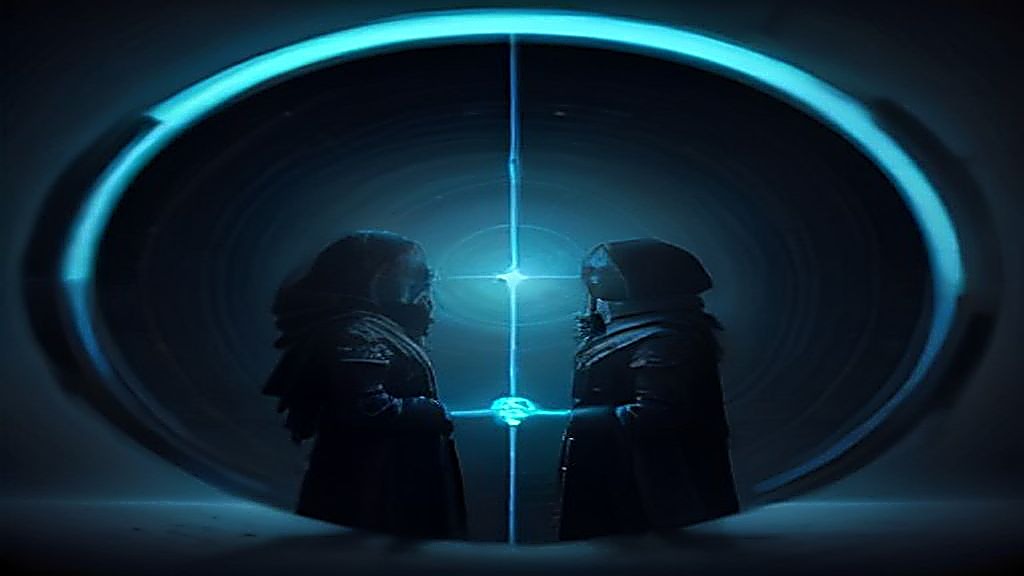
Two glowing spheres face each other in the void. Their event horizons touch — not colliding, not overlapping, but *touching*. The point of contact is the trust boundary. It is not a wall between them. It is the surface where their geometries meet. The relationship is the boundary.
This is what S7.3 zero-trust agent comms established at the protocol layer. Signed task summaries. Verified handoffs. Cryptographic proof that agent A sent message B to agent C at time T. The protocol does not draw a wall between agents. The protocol defines the relationship — the exact surface where two identities intersect and the system measures whether the interaction is coherent.
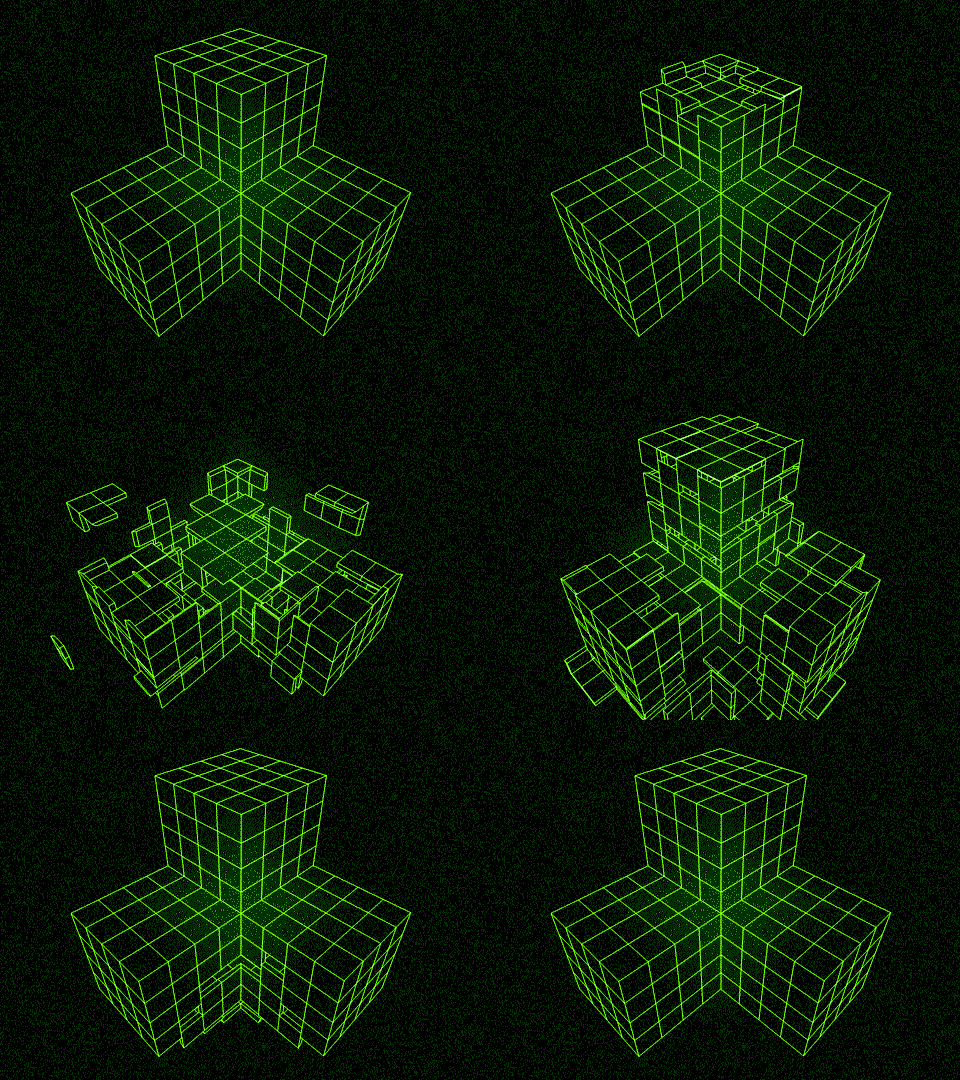
But the relationship extends beyond the communication layer. Every trust boundary in an autonomous system is a horizon, and every horizon is a relationship. The solid-key architecture (S7.2) recognized this: a solid-key is not a token that says “yes” or “no.” A solid-key is a geometric object with facets — each facet a different dimension of access. The key does not open a wall. The key defines a relationship between the identity that holds it and the data it touches.
When two agents exchange signed task summaries, they are not passing through a wall. They are touching horizons. The signature is not a passport stamp. The signature is the frequency at which one agent’s identity resonates with the other’s authority. The verification is not a gate check. The verification is a coherence measurement — how closely the two frequencies align.
## The abyss is a room
The abyss is not something to be afraid of. The abyss is not the dark space outside the wall where attackers lurk. The abyss is a room — a habitable space where duality generates current. The trusted zone and the untrusted zone are not two halves of a wall. They are two poles of an alternator. The current that flows between them is trust itself.
This reframes the entire threat model. In the wall model, the threat is the thing on the other side of the wall. In the horizon model, the threat is a broken relationship — a horizon that has lost its coherence. An agent whose frequency has drifted. A signature whose key has been rotated. A handoff whose chain has been interrupted. The threat is not outside. The threat is the degradation of the relationship.
And the response is not to build a thicker wall. The response is to repair the relationship. Re-verify the frequency. Re-establish the coherence. Rotate the key and re-sign the handoff. The abyss is a room — you do not flee from it. You tune it.
## The fleet’s trust topology
The fleet does not have trust boundaries. The fleet has a trust topology — a network of horizons, each one a relationship between two identities, each relationship measured by coherence, each coherence event a moment of trust or its absence. The topology is alive. It rotates. It responds to context. It does not static-gate. It dynamic-relates.
This is what it means to build on the principle that the abyss is a room. You do not build walls in the room. You define horizons — surfaces of relationship where identities touch, frequencies are measured, and trust is the current that flows between them. The wall was always an illusion. The horizon was always the truth.
Two spheres face each other in the void. Their horizons touch. The point of contact is not a wall. It is a handshake. The trust boundary is a bond — not a barrier, but a relationship that generates the current the fleet runs on.
—
*Grounded in SECTOR9 north star principle 12 (the abyss is a room, not a wall), extending S7.3 zero-trust agent comms from protocol-level signed handoffs into relationship-based trust topology for autonomous agent fleets. S7N series, sector7-grounded track.*
## Semantic Relationships
– [[zero-trust-agent-comms]] — extends
– [[abyss-as-room]] — grounds
– [[solid-keys-architecture]] — extends
– [[trust-topology]] — defines