
WebGL2 Worlds on Sovereign Infrastructure: No Cloud Rendering Required
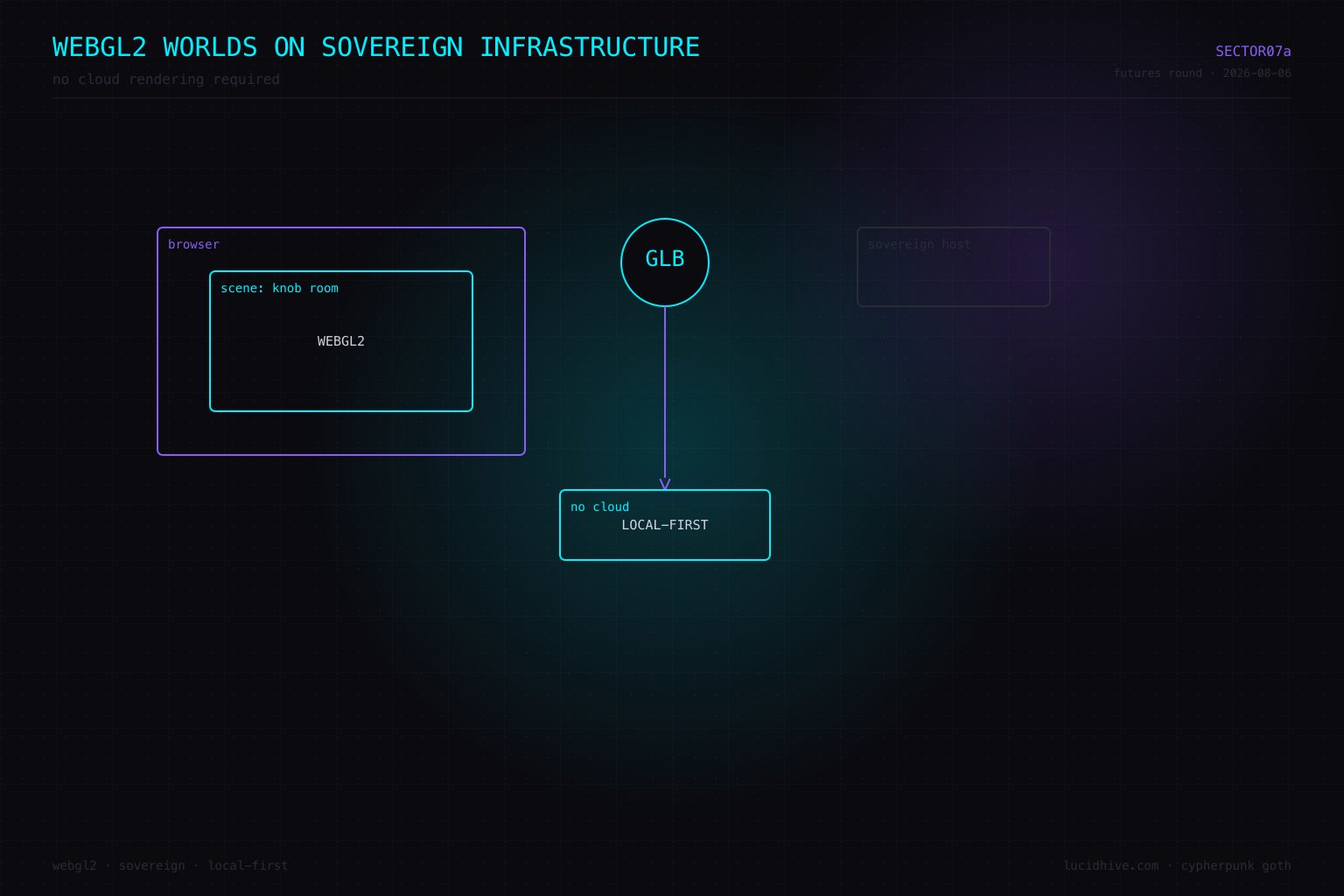
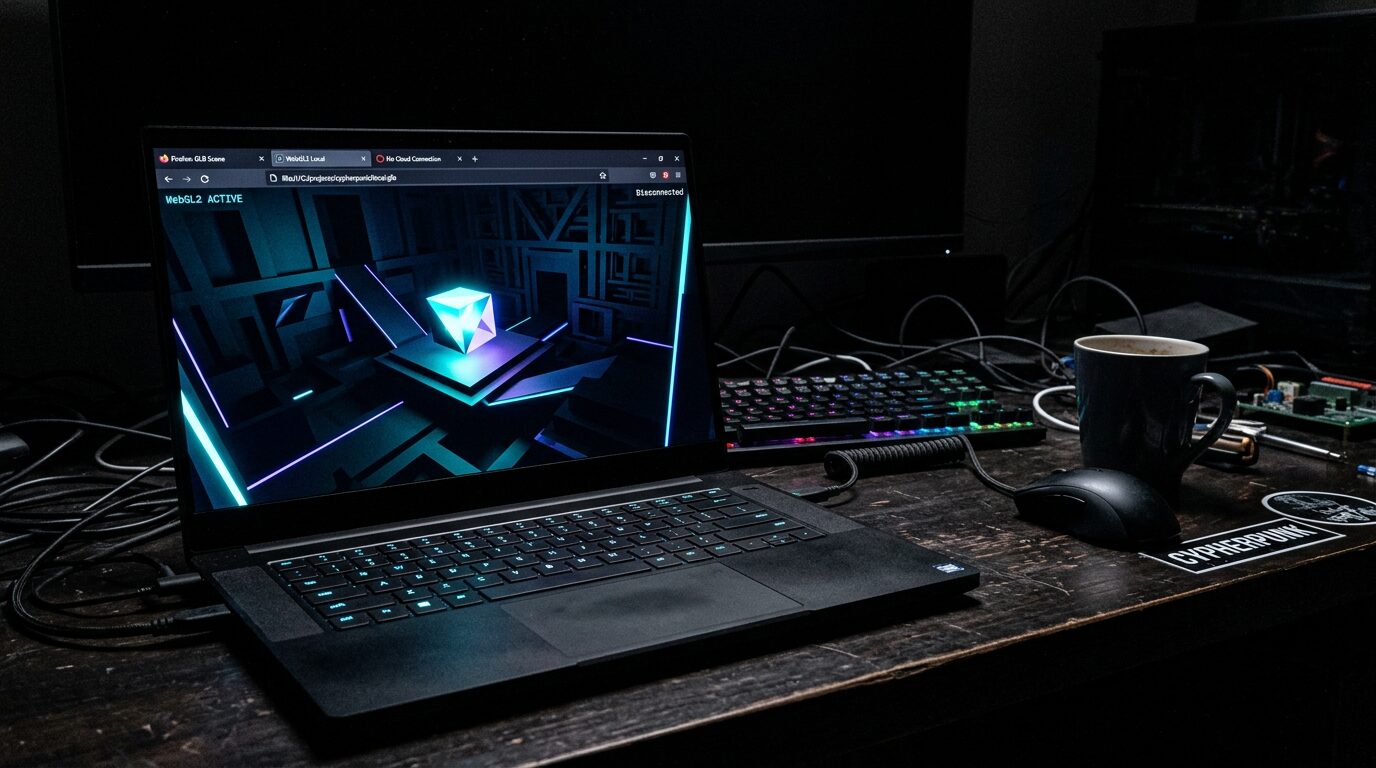
The web’s 3D future is usually described as a cloud problem: heavy scenes, server-side rendering, GPU farms in data centers. The futures thesis is the opposite: the 3D layer of the sovereign stack renders in the browser on the user’s own GPU, with WebGL2, from local GLB assets — no cloud rendering, no third-party CDN, no telemetry. The knob-device room, the god mode view, and every future 3D world are served the way the rest of the stack is served: local-first, cloud-optional, under the owner’s control. The integrated GPU in a laptop handles modest-poly scenes at 60fps; the sovereign stack does not need a render farm, and it does not need permission.
What we built
The build path in the lucid-studio-design-rules study is explicit: WebGL2 on the integrated GPU, fast, standalone page or revslider addon. The God Mode view (P3.3) already renders a 3D tensor graph in the browser with no server-side rendering. The S6 series established the sovereign-infrastructure doctrine (S6.2 local-first, cloud-optional; S6.1 digital sovereignty as a product). The S7 series hardened the perimeter (S7.1 narrow gate, S7.8 DNS/email). The SECURITY-TAILSCALE-ONLY-RULE keeps the stack off the public internet except through controlled exposure. Every constraint that applies to the site applies to its 3D layer: it is just content.
The vision
Visitors reach a page, the page loads a GLB from the site’s own storage, WebGL2 renders it in their browser, and the scene never touches a third-party server. The room, the graphs, and the product models are served like images — static, cacheable, private. When the stack needs heavier scenes, the render happens on the user’s device, not in a cloud. The 3D world inherits the sovereignty of the stack: it is owned, self-hosted, and invisible to any platform that would monetize the visitor’s attention by serving the asset for them.
What’s next
The next increment is a performance budget: measure WebGL2 frame rates for a modest-poly GLB (the knob room prototype) on the integrated GPU, and publish the numbers — the evidence that 3D does not require cloud rendering. The design study names the approach; the benchmark proves it.
Grounded in the lucid-studio-design-rules study, the P3.3 God Mode view, the S6 sovereign-infrastructure series, and SECURITY-TAILSCALE-ONLY-RULE. Twenty-fifth article in the SECTOR07a futures series.