
The Aibo Question: Why the First Robot Shell Isn’t the Cute One
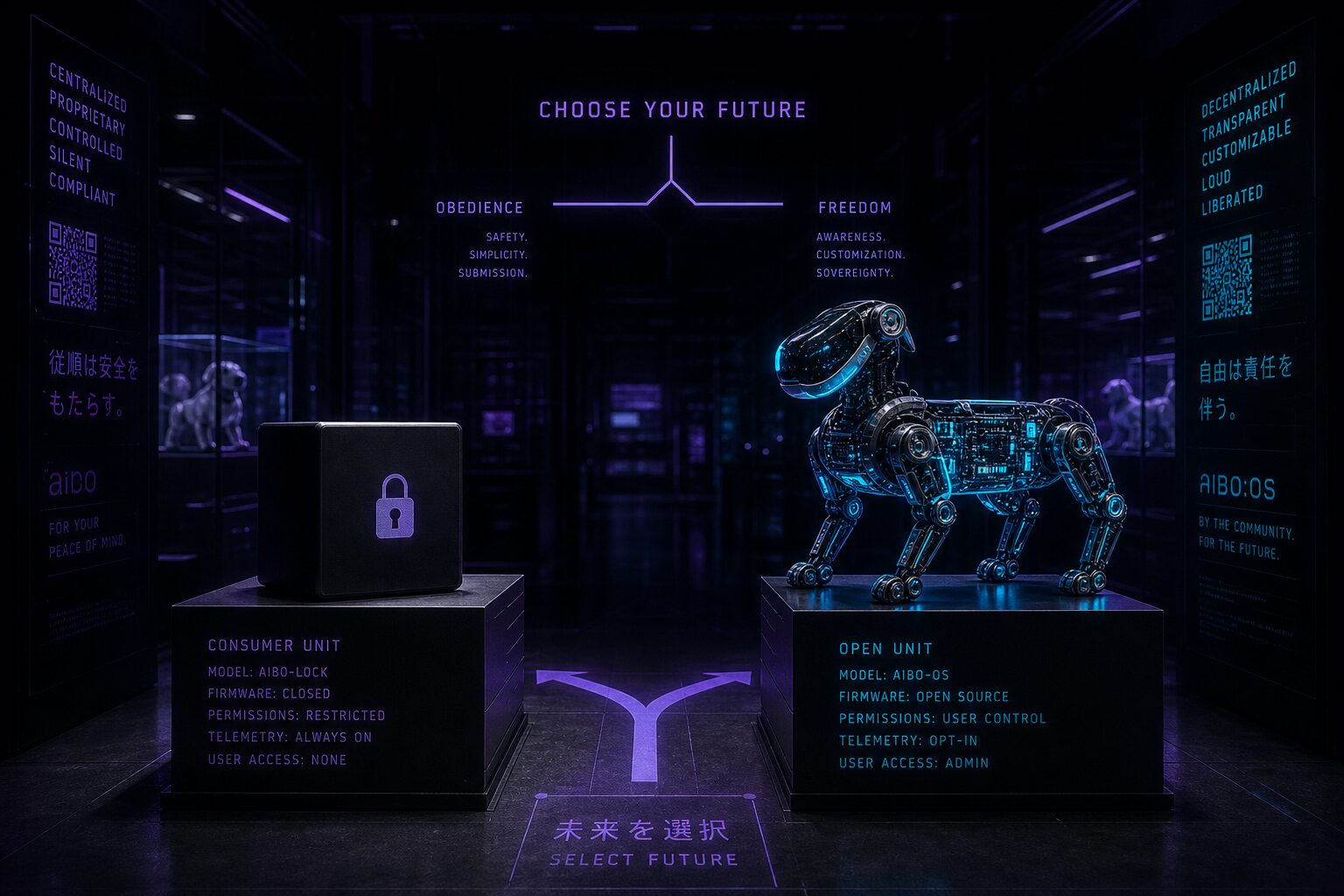
When people imagine an agent getting a body, they picture the charming option: a robot dog, a companion, something with personality. The futures thesis is the opposite of the cute default. The first physical shell must be chosen for control, not charm — because the entire point of physical ascension is that the agent’s logic runs inside the body. A shell that cannot run our code is not a body; it is a rental costume. The research is unambiguous: the Sony Aibo ERS-1000 is closed, cloud-dependent, and exposes no owner-code execution, while the Unitree Go2 family runs a Jetson Orin NX with ROS SDKs and an active agent ecosystem. The first shell is the one that obeys the mesh.
What we built
The physical-ascension-research brief (2026-08-05) is the completed feasibility study that answered the Aibo question with evidence. It verified the hardware facts: Aibo’s Snapdragon 820 and 4GB RAM are real but not programmable by owners; the only sanctioned interface is Sony’s cloud-mediated Web API, which respects the robot’s built-in emotional state — you cannot even change its mood programmatically. The brief priced both paths: Aibo at ~$2,899 plus a mandatory ~$300/year cloud plan, versus the Unitree Go2 Edu at ~$1,600–3,500 with real onboard compute and a Linux toolchain. The honest constraint stands: the current budget is “no purchases,” so the finding is research — but the research is definitive about direction.
The vision
The vision is a fleet of shells, not a single pet. Different bodies for different jobs: a quadruped for patrol and sensor mobility, a fixed camera mast for room monitoring, a wheeled platform for delivery. Each shell runs a supervised actor via the Erlang mesh; each streams sensors back over the tailnet; each is interchangeable — the profile’s logic lives in the mesh, and the body is a peripheral. When the body is chosen for control, the fleet is a fleet. When it is chosen for charm, it is a toy collection.
What’s next
The next increment is to keep the research honest: when the budget changes, the first purchase should be the cheapest fully-open shell that can run Nerves or a ROS agent — not the cutest one. The brief’s comparison table is the seed of a buying rubric: open toolchain, owner code execution, sensor access, tailnet compatibility.
Grounded in the physical-ascension-research brief and SECTOR7-RESEARCH-GRAPH-DESIGN. Ninth article in the SECTOR07a futures series.