
Visual
Narratives: Prompt Engineering as Craft, Not Luck
A prompt is a record of intent translated into instructions a visual
system can execute. The difference between luck and craft is whether the
next render inherits the last render’s lessons.
That distinction matters because a creative pipeline should carry
meaning without improvised restarts. Prompt engineering makes that
outcome repeatable.
🔓 PUBLIC —
The prompt is the source before the render
The prompt is the source before the render
The SECTOR9 North Star describes information as the ground of being
and reality as a rendering engine. In a media studio, the prompt is the
information layer that projects into measurable form. Before a model
draws a subject, the prompt establishes palette, geometry, light,
hierarchy, texture, and purpose. The image is the print; the prompt is
the source record.
A vague instruction leaves the renderer to make the important
decisions. “Dark cyberpunk” names a mood but not a visual argument. A
production prompt names the canvas, subject, focal point, style anchors,
exclusions, and intended use. It turns atmosphere into a bounded
brief.
Specificity is not verbosity. It states relationships. Cyan may be a
rim light, violet may carry depth, and gold may appear only as a small
signal node. Those roles tell the model how colors behave and tell a
reviewer why the result belongs to the brand.
🔓 PUBLIC — Five
layers make a visual narrative
layers make a visual narrative
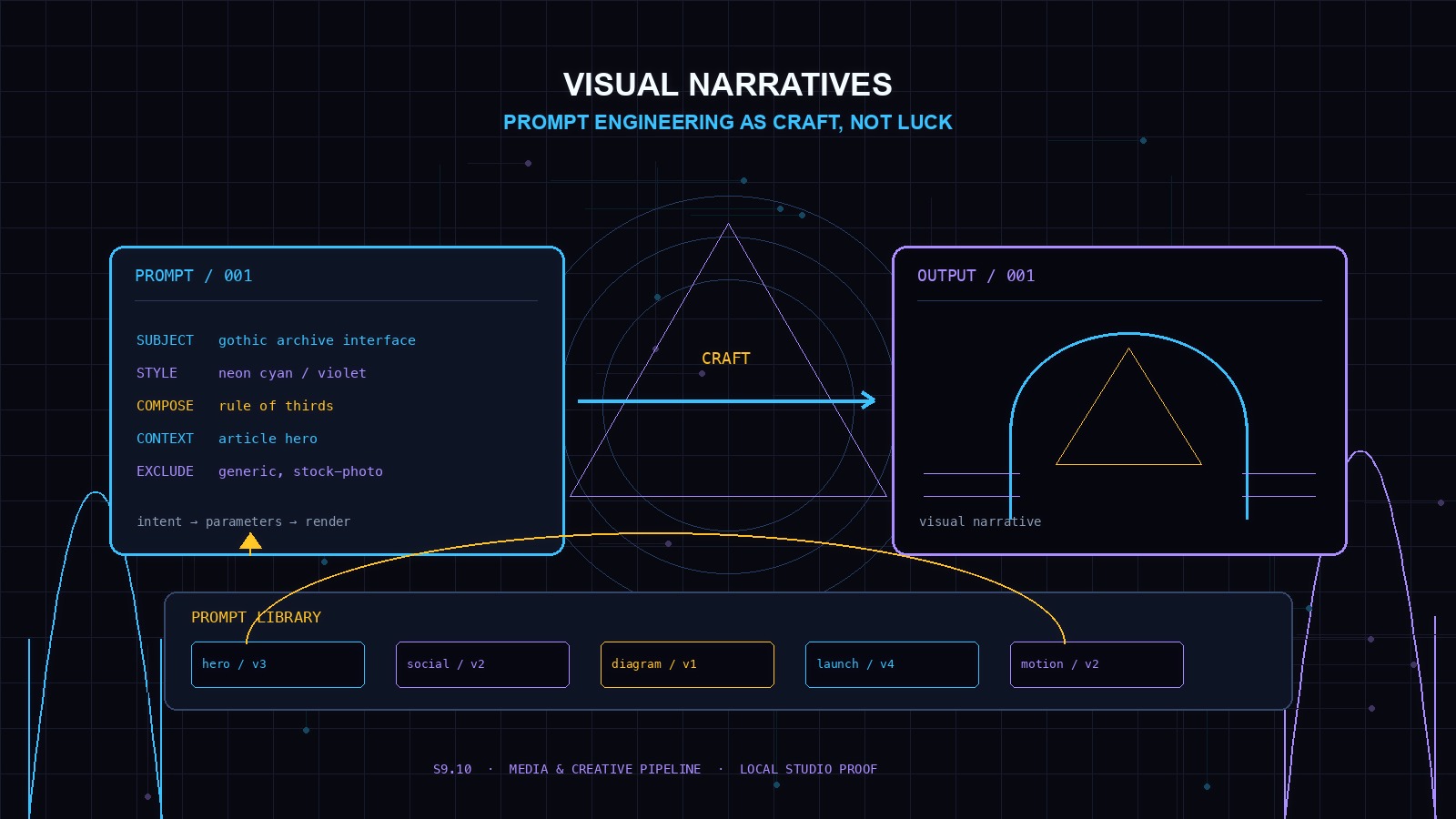
A production prompt can be organized into five layers. They are
useful because each layer answers a different question and can be
revised independently.
Subject. What is actually visible? A subject should
be concrete enough to photograph, draw, or model. A trading desk becomes
a holographic trading desk suspended in a dark field, surrounded by
translucent data planes. Specific nouns give the model something to
assemble.
Style. What is the visual language? Style is not a
mood word; it is a repeatable set of materials. For a cypherpunk-goth
system, that means a deep black canvas, neon cyan and violet light,
gothic architectural silhouettes, circuit traces, controlled glitch, and
restrained gold. The North Star’s frequency principle becomes practical
here: a consistent color and texture vocabulary gives every output a
recognizable voice.
Composition. Where does the eye travel? A 16:9
canvas is only a ratio. The stronger instruction names the foreground,
background, focal point, depth, and light direction. Centered symmetry
can make a system feel ceremonial; asymmetry can create tension and
imply movement. Composition is the grammar that turns objects into a
scene.
Context. What is the asset for? A blog hero, product
photograph, vertical short-form clip, and technical diagram cannot share
every parameter. Context tells the renderer which elements must remain
readable, where safe space belongs, and what can be cropped without
breaking the story.
Narrative. What should the image make the viewer
understand? A security article and a branding article may use the same
palette but must make different arguments. The narrative layer gives the
other four a purpose. It is the difference between a moody picture and a
visual that carries a thesis.
🔓 PUBLIC — A
brand voice becomes a translation layer
brand voice becomes a translation layer
When a creative operation serves many channels, brand identity cannot
live in someone’s memory. It needs a translation layer that turns
decisions into parameters. Palette values, typography roles, image
vocabulary, composition rules, and negative keywords should be explicit
and reusable.
This is the same principle behind a good API: one system speaks a
stable language to another. The brand brief says what the work is
becoming. The visual tokens say how that intention is expressed. The
prompt template says how the renderer should build the asset. A
validator says whether the result followed the contract.
The separation is useful because it makes change traceable. If a
campaign needs a colder blue, the token changes once. The new value
should either reach the active template or be marked as a pending
migration. If it silently disappears, the studio is no longer operating
from a system; it is relying on whoever happened to make the next
render.
🔓 PUBLIC — The
feedback loop is where craft appears
feedback loop is where craft appears
A first prompt is a hypothesis. The useful moment comes after the
image exists and someone compares it with the intent. What did the model
preserve? Where did the hierarchy collapse? Did the crop leave the
subject visible? Did the style drift toward a generic template? The gap
becomes a lesson only when it is recorded.
A disciplined loop has four movements: render, compare, classify, and
revise. The revision can change one variable at a time. Change the
composition without changing the palette. Then change the palette
without changing the subject. Small comparisons make improvement legible
and prevent a lucky result from being mistaken for a general rule.
The North Star’s record principle applies to visual production. Keep
the prompt, model and workflow version, seed when available, output, and
review reason. Preserve a rejected candidate too. A failure is evidence
about the specification: the prompt was ambiguous, the context was
wrong, or the model exposed a boundary the team had not named.
Light is the output device, but the review is what gives light
direction. The studio does not ask an image to prove its value through
spectacle. It asks the image to communicate the thesis, meet the brand
boundary, and remain legible in the channel where it will be used.
🔓 PUBLIC — A
prompt library compounds visual judgment
prompt library compounds visual judgment
The most valuable prompt artifact is not the image alone. It is a
small library of tested decisions. A library entry can name the use
case, the subject, the style anchors, the composition, the context, the
exclusions, the renderer settings, and the quality result. A keeper is
not simply beautiful; it is reliable for a declared job.
This library becomes a practical form of continuity. A new article
starts with the closest working template instead of an empty prompt box.
The team changes the subject and the context while preserving the
decisions that have earned trust. A social crop can inherit the world of
a hero image without pretending to be the same image.
Versioning matters here. A small change to a negative phrase or
composition rule can alter the meaning of every downstream render. Give
the change a name, date it, record what it is intended to improve, and
keep the prior version available. The library should show how the visual
language evolved rather than hiding its history.
Vibe is data when the studio makes that data explicit. Three or four
adjectives—meditative, glitchy, urgent, defiant—can become a checkable
style description rather than a private reaction. The adjectives are not
decoration. They help a reviewer decide whether an image still carries
the intended frequency.
🔓 PUBLIC — From craft to
pipeline
pipeline
A reliable creative pipeline has three capabilities: a structured
prompt format, a feedback loop that scores or explains the result, and
an execution layer that can reproduce the specification. The execution
layer may be a local media tool, a ComfyUI workflow, or a publishing
adapter. It carries intent faithfully; it does not hide the decisions
that produced the result.
The distinction between luck and craft is not that craft eliminates
variation. It is that variation becomes bounded and useful. A lucky
prompt depends on a favorable interpretation. A crafted prompt gives the
model a stable subject, a named style, a deliberate composition, a clear
context, and a feedback history. When the output misses, the system can
identify the miss and make a controlled revision.
That is why a visual narrative can scale without becoming generic.
The system repeats the relationships, not the pixels. The same visual
voice can carry an article, a launch, a diagram, and a moving image
while allowing each medium to do its own work.
The final artifact is a record another person or agent can continue.
It says what the work is communicating, which choices are constant,
which are variable, what was rejected, and what should be checked next.
Information becomes a prompt, the prompt becomes a render, and the
render becomes evidence for the next decision.
Send intention into the renderer. Receive a visual record back. Learn
from the gap. Repeat.