
# Tier 1–5: Platonic Pricing as Access Architecture
> **Draft — S6.8 · series: CONTENT-ROADMAP-99 S6 (Web 4.0 / Digital Business) · status: DRAFT · grounding: wiki system-overview · kot-os-competitive-analysis · MASTER-INDEX-BRIDGE clusters · wiki_concepts: platonic-solid-access-architecture, pricing-tiers, system-overview, tier-5-integration, tier-3-build, tier-4-build · skills: hermes-agent, kanban-orchestrator, moses-governance · tags: ai-agents, platonic-solid-access, tiered-pricing, web-4-0, digital-business, sovereign-infrastructure, solid-keys, lucid-studio, council-system, local-first, subscription-model, access-control, hermes-agent, kanban-orchestrator, moses-governance**
—
Most SaaS pricing pages present tiers as a feature ladder — more storage, more seats, more support. The geometry is incidental. In the Kingdom of Truth, the geometry is the policy. The Platonic Solid Access Architecture (PSAA) maps five Platonic solids to five access tiers, and those tiers map directly to Lucid Studio’s subscription model. The result is a pricing structure where the shape of the key determines what the holder can do, and the pricing reflects the depth of that access, not just the quantity of features stacked on top.
This is not a metaphor applied after the fact. It is an architectural commitment: the access control system and the pricing model are the same object.
## The five solids, five tiers
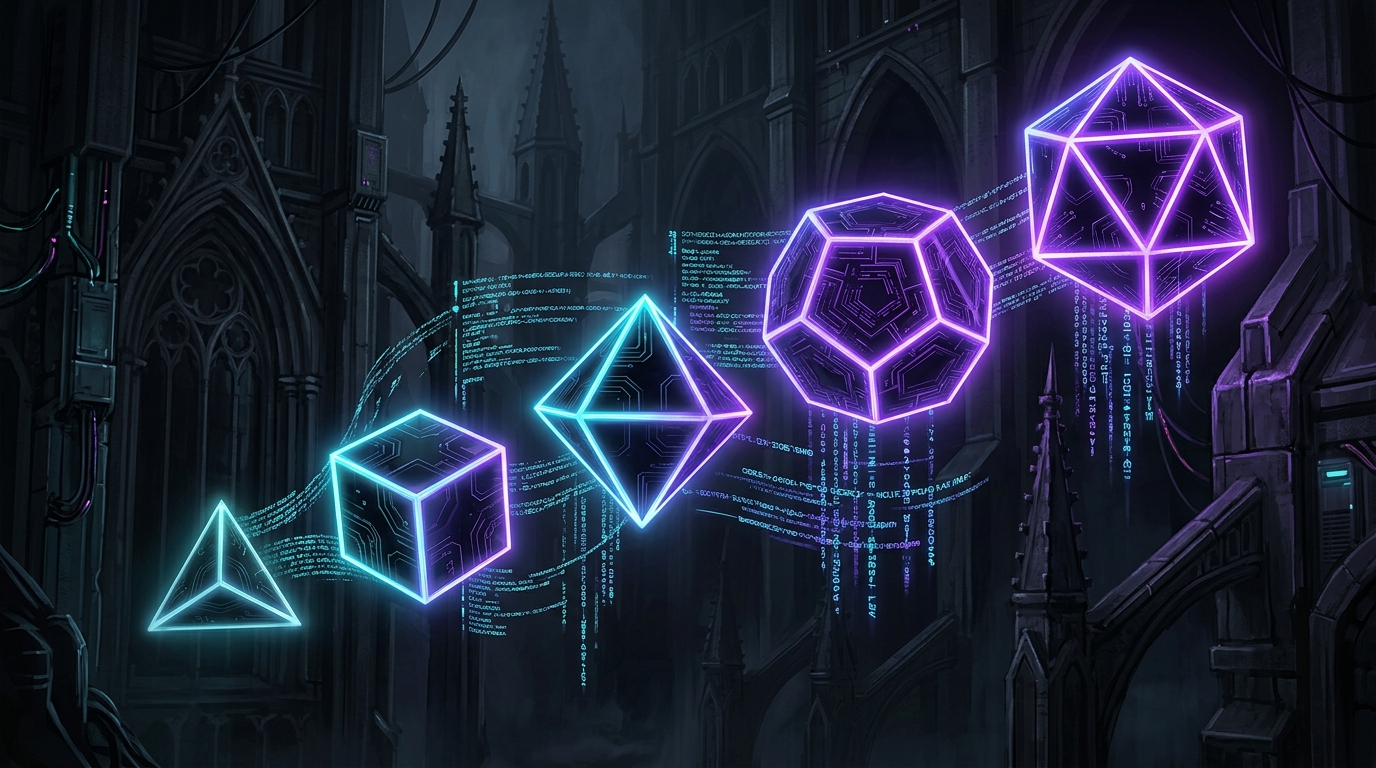
There are exactly five Platonic solids in Euclidean geometry. Each one maps to a tier in the PSAA system, and each tier corresponds to a Lucid Studio subscription level. The mapping follows from the geometric properties of each solid.
**T1 — Tetrahedron (4 faces).** Starter tier at $99/month. One subsite, one agent, one OpenCode Go seat. The tetrahedron encodes minimal access: few skills, narrow scope, short session lifetime. A new operator gets the foundation — orchestration through Hermes, security through OpenFang, basic creative capability through OpenClaw — but the geometry constrains what the system can do. The solid-key grants access to core skills and blocks everything else. The constraint is the point: T1 operators learn the system without the risk of unbounded access.
**T2 — Cube (6 faces).** Pro tier at $249/month. Five subsites, three agents, full Fluent plugin suite. The cube adds dimensions — more faces (skills), more vertices (contexts), more edges (relationships between them). The Pro solid-key unlocks the creative pipeline, the DevOps layer, and the knowledge OS with ChromaDB vector search. The agent council expands from one to three, each with its own solid-key scoped to the tier. A content generation agent gets creative skills but not security primitives. A support agent gets CRM skills but not infrastructure tools. The geometry encodes the separation of concerns.
**T3 — Octahedron (8 faces).** Enterprise tier at $599/month. Twenty-five subsites, ten agents, white-label and API access. The octahedron is the first solid with enough geometric complexity to encode multi-tenant relationships. Enterprise operators run multiple client deployments through a single Council, each client’s data isolated by solid-key scope. The two-way sync between Hermes and WordPress activates at T3, creating a bidirectional orchestration loop where agent actions on the kanban board propagate to the CMS and vice versa. The setup fee ($499) filters non-serious buyers and covers provisioning labor.
**T4 — Dodecahedron (12 faces).** Sovereign tier at $1,499/month. Unlimited subsites, unlimited agents, source access, custom development, dedicated infrastructure. The dodecahedron approaches the geometric limit of Platonic complexity. At T4, the operator owns the full stack. The solid-key grants access to every skill, every MCP server, every memory layer. Custom development means the operator can modify the Council architecture itself — add new specialist profiles, extend the kanban board’s schema, wire new MCP servers. The access control does not prevent this because the T4 scope field is unbounded.
**T5 — Icosahedron (20 faces).** The geometric limit. In PSAA, T5 exists as the theoretical maximum — all Platonic faces, all access. In practice, T4 Sovereign already reaches this level. T5 is the architectural ceiling: the point where the operator has transcended the tier model entirely. It maps to the “sovereign” concept in the KOT-OS competitive analysis — not just a pricing tier, but a philosophical position where the operator controls the infrastructure the way a sovereign state controls its borders.
## Why geometry beats feature lists
Traditional SaaS pricing is a feature spreadsheet — more storage, more seats, more support. The boundaries between tiers are arbitrary: product managers draw lines based on what the market will bear, not on any structural property of the system. The result is tier creep: features migrate between tiers, pricing adjusts quarterly, and the customer never quite knows what they are paying for.
PSAA inverts this. The tier boundaries are geometric. A tetrahedron has exactly 4 faces — not 3, not 5. An octahedron has exactly 8 faces — not 7, not 9. The number of faces maps to the number of skill domains the solid-key grants access to. The geometry is fixed by mathematics, not by product decisions. This means the access architecture cannot drift. A T2 customer does not get T3 skills because the cube does not have the faces to encode them. The pricing follows from the geometry: more geometric complexity means more access means higher cost.
## The dual-token pattern
Every solid-key carries two halves: KEY (what access is granted) and KILL (what revokes it). This is not a standard JWT claim or a role-based access control list. It is a cryptographic token that simultaneously encodes the permission boundary and the revocation mechanism. The KILL half carries eight triggers: tier_downgrade, session_expired, identity_compromise, budget_exceeded, violation_
When a T3 Enterprise customer exceeds their agent budget, the budget_exceeded KILL trigger fires automatically, the solid-key’s KEY half is invalidated, and the Council redirects the customer’s agents to a degraded T2 scope until the billing cycle resets. The customer experiences a transparent downgrade, not a hard stop. The geometry handles the transition because the octahedron can project onto the cube — the T3 solid-key contains a T2 sub-key that activates under KILL conditions.
This is what separates PSAA from standard tiered pricing: the tiers are not just feature bundles, they are geometric access policies with built-in revocation.
## The memory hierarchy per tier
Each tier has its own memory layer, creating a four-tier cache hierarchy that maps to the solid geometry:
– **Micro cache (~5ms):** Per-agent, agent-only. The tetrahedron’s memory is its own faces — what the agent has directly observed.
– **Macro cache (~20ms):** Per-tier, shared across agents at the same level. The cube’s memory is shared vertices — what all T2 agents can access together.
– **ChromaDB (~100ms):** Full vector store, all tiers. The octahedron’s memory is the complete graph — semantic search across the entire knowledge base.
– **State.db FTS5 (~200ms):** Full-text search, all tiers. The dodecahedron’s memory is the complete vault — every concept, every entity, every article.
A T1 Starter customer gets micro cache only. A T4 Sovereign customer gets all four layers. The memory hierarchy is not a separate feature — it is a direct consequence of the geometric access architecture.
## The practical implication
For the small business operator choosing a Lucid Studio tier, the implication is straightforward: you are not buying features, you are buying geometry. Starter at $99 gives you a tetrahedron — simplest access shape, narrowest skill scope, smallest memory footprint. As your business grows, you change shapes, not add features. Pro at $249 gives you a cube. Enterprise at $599 gives you an octahedron. Sovereign at $1,499 gives you a dodecahedron.
Each shape is more complex than the last, not because someone decided to add features, but because the geometry demands it. More faces means more skill domains. More vertices means more deployment contexts. More edges means more relationships between them. The pricing page is a geometry lesson, and the subscription is an access policy.
—
*Grounded in the wiki concepts `platonic-solid-access-architecture`, `pricing-tiers`, `system-overview`, `tier-5-integration`, `tier-3-build`, and `tier-4-build`, plus the MASTER-INDEX-BRIDGE clusters on Web 4.0 / digital business management. Eighth article in the S6 series. Follows S6.3 on rent-to-own; this one specifies how the access architecture maps to the pricing model.*