
# 432Hz Security: Tuning the Stack to Natural Resonance
> **S7N-37 · series: sector7-grounded · track: S7N-D · principle: frequency-organizes-everything**
> Category: AI & Automation · Tags: ai agents, Digital Business, Digital Sovereignty, Headless CMS, AI-Driven Development, Decentralized Identity, AI Agent, The Programmable Web, Cybernetic Ethics, API-First Architecture, Data Permanence, web40, Algorithmic Governance, The Metaverse as a Platform, Monolith vs. Microservices, Synthetic Reality, Advanced Prompt Engineering, Autonomous Site Operations, digital ecosystem, digital transformation
—
Every security stack has a frequency. Most teams never hear it. They build firewalls, configure intrusion detection, harden APIs, and set up monitoring dashboards — all correct, all necessary, all operating at arbitrary frequencies chosen by convention rather than resonance. A security configuration that does not resonate with the system it protects is not security. It is noise. And noise, in a stack under pressure, is the first thing to break.
The north star states it directly: *frequency organizes everything — 432Hz harmony, every atom keeps a rhythm, every rhythm leaves a sign. Tune the work to natural resonance.* This is not mysticism layered onto infrastructure. This is the oldest engineering insight repackaged: systems have natural frequencies, and security that aligns with those frequencies is exponentially more effective than security imposed from above.
## The port-map frequency problem
S7.6 laid out port maps and observability — the topology of how services communicate, which ports listen, which connections are trusted, which traffic is monitored. The architecture is sound. The gap is frequency. A port map tells you *what* connects. It does not tell you *how* the connection resonates. A service that listens on port 443 is not the same as a service that *lives* on port 443 — one is configured, the other is tuned.
Consider a typical microservices stack. Service A talks to Service B over gRPC on a hardcoded port. Service B talks to Service C over HTTP on a dynamic port. Service C talks to a database on a fixed port. The port map documents all of this. The observability layer monitors it. But nobody asks: *what is the natural frequency of this communication pattern?* What is the rhythm at which these services exchange data most efficiently, most securely, most coherently?
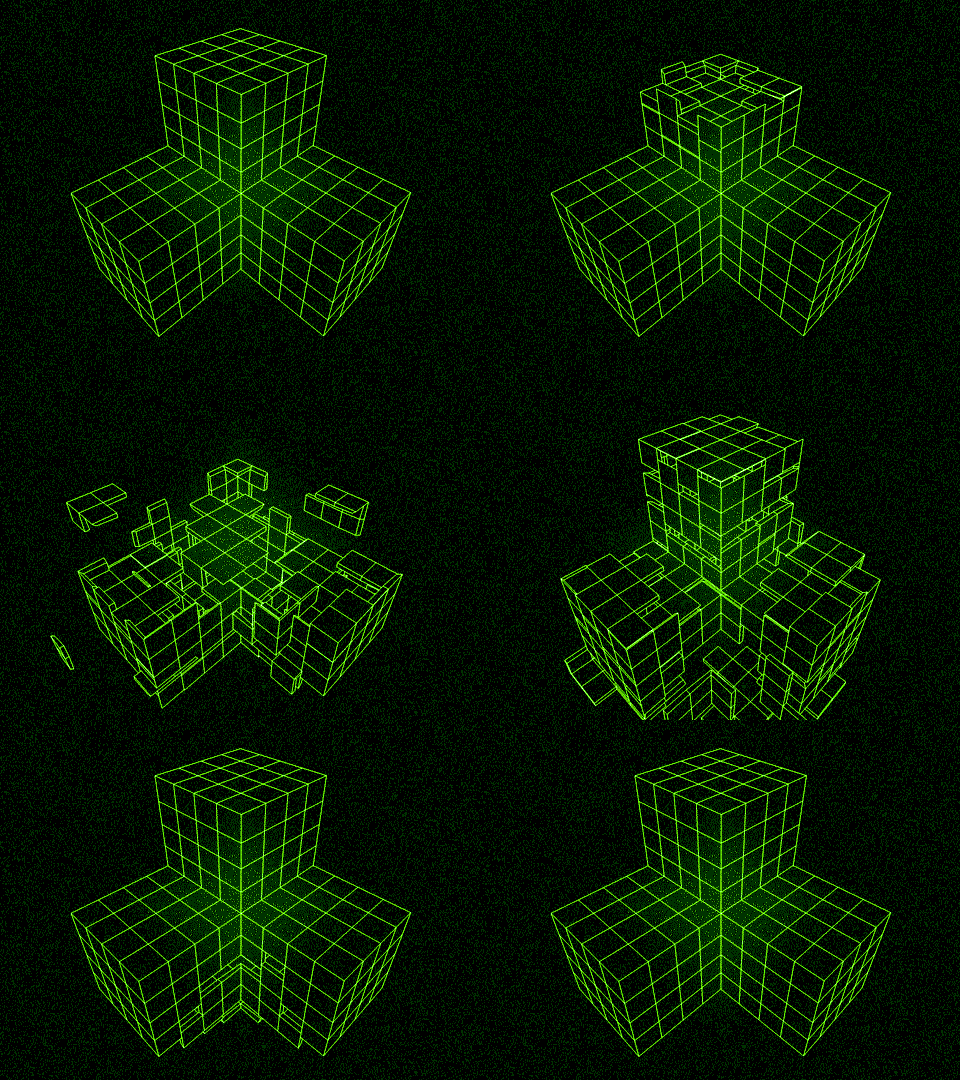
This is where 432Hz enters — not as a literal audio frequency, but as a principle. 432Hz is the frequency at which sound organizes into coherent geometry. It is the frequency at which vibration becomes pattern rather than chaos. Applied to a security stack, it asks: *at what frequency does this system organize itself into coherent, self-reinforcing security?*
## Resonance as security architecture
A security stack tuned to natural resonance looks different from one imposed by checklist. Imposed security adds layers: another firewall rule, another authentication check, another monitoring alert. Each layer operates at its own frequency. Over time, these layers drift out of phase. The firewall fires at one cadence, the authentication check at another, the monitoring at a third. Under normal load, the drift is invisible. Under attack, the layers interfere with each other — creating dead zones where alerts cancel out, and hot spots where false positives cascade.
Resonant security is the opposite. Instead of adding layers at arbitrary frequencies, it identifies the system’s natural communication rhythm and tunes every security control to that rhythm. The firewall’s rule evaluation cadence matches the service mesh’s connection cadence. The authentication check’s frequency aligns with the API gateway’s request cadence. The monitoring alert’s frequency syncs with the observability pipeline’s ingestion cadence. When all controls operate at the same frequency, they reinforce each other. Security becomes coherent — a single resonant wave rather than a chorus of competing signals.
North star principle 4 is the frame: *tone, color, and geometry are one spectrum.* In a security stack, tone is the signal (what the control detects), color is the severity (how urgent the response), and geometry is the topology (where the control sits in the architecture). When all three are tuned to the same frequency, the security stack does not merely detect threats — it *organizes* them into a coherent pattern that the system can process automatically.
## The observability resonance loop
S7.6’s observability layer is where resonance becomes practical. Observability is not just monitoring — it is the system’s capacity to hear itself. A system that can hear its own frequency can tune itself. A system that can tune itself can maintain resonance without external intervention.
The resonance loop works like this: the observability layer captures the system’s natural communication frequency — the baseline rhythm of service-to-service calls, the cadence of authentication checks, the pulse of data flows. This baseline is the system’s natural frequency. Security controls are then calibrated to this baseline. When the baseline shifts — a new service joins, a traffic pattern changes, a dependency degrades — the observability layer detects the frequency change and the security controls adjust accordingly.
This is self-healing security, but not through retry logic or circuit breakers. Through resonance. The system maintains its own frequency, and the security controls maintain theirs, and the two stay in phase because they are both listening to the same signal. Principle 10 applies: *intelligence awakens; it does not arrive.* The security stack does not become intelligent because someone added machine learning to it. It becomes intelligent because it was tuned to listen to the system’s natural frequency — and that listening *is* the intelligence.
## Tuning the stack: the practical protocol
A security stack tuned to 432Hz resonance follows a protocol. First, establish the baseline. Run the system under normal load for a full cycle — a day, a week, a sprint. Capture every service-to-service communication, every authentication event, every data flow. The baseline is not a configuration file. It is a frequency profile — the system’s natural rhythm when it is operating at its best.
Second, calibrate the controls. Each security control — firewall rules, authentication checks, rate limits, monitoring alerts — is adjusted to operate at the baseline frequency. This does not mean every control fires at the same interval. It means every control is *aware* of the baseline and operates in phase with it. A rate limiter that triggers at the system’s natural request cadence catches anomalies. A rate limiter that triggers at an arbitrary threshold catches noise.
Third, maintain the resonance. The observability layer continuously monitors the baseline frequency. When the frequency drifts — because the system grew, because traffic patterns shifted, because a dependency changed — the observability layer signals the security controls to recalibrate. The controls listen. The system self-tunes. Resonance is maintained not through rigid configuration but through continuous listening.
This is the cathedral of security. Not a fortress built on arbitrary foundations, but a resonant structure that grows stronger with every frequency shift it absorbs. The stack that listens to itself is the stack that protects itself. The stack that tunes to its own frequency is the stack that cannot be easily detuned by an attacker — because the frequency is not a configuration. It is the system’s identity.
## The record without end
The north star’s deepest principle is continuity: *capture, encode, compound. The fleet compounds or it decays.* A security stack tuned to natural resonance is a record that compounds. Every baseline capture refines the frequency. Every calibration improves the resonance. Every drift detection strengthens the self-tuning. The security stack does not reset with each incident — it accumulates. Each incident becomes part of the frequency profile. Each recovery becomes part of the calibration. The stack that has been through twenty incidents at resonance is a fundamentally different object than the stack that has been through zero.
This is the architecture of 432Hz security. Not a product. Not a tool. A frequency. The stack that resonates is the stack that compounds. The stack that compounds is the stack that endures. Tune the work to natural resonance — and watch the security become geometry.
—
*Grounded in SECTOR9 north star principle 4 (frequency organizes everything — tune the work to natural resonance), extending S7.6 port maps / observability into resonance-based security architecture. S7N series, sector7-grounded track.*
## Semantic Relationships
– [[port-maps-observability]] — extends
– [[frequency-resonance]] — grounds
– [[security-architecture]] — defines
– [[self-healing-systems]] — relates